Tuesday, April 22, 2014

Daemon Parallel by Roy Gill

Daemon Parallel

20504167 

Title: Daemon Parallel
Author: Roy Gill
Series: Daemon Parallel
Publisher: Kelpies
Publication Date: March 20 2014
Source: Netgalley

Goodreads Summary: "Worlds collide. Promises broken."

Cameron's father is dead and his inheritance is... rather unusual.
He has the power to world-shift: travel between the Human and Daemon dimensions and the Parallel - a realm where the two worlds meet.

Between battling daemons and allying with werewolves, Cameron's new life is already pretty complicated but things are about to get even more dangerous...

My Thoughts: This book was great. Super fun and interesting - even though I'm not a thirteen year old boy. I thought the idea of having parallel worlds that can be crossed simply by activating the right music in your mind was totally awesome. I also thought it made total sense that the parallel was strongest in Edinburgh because it is one complicated city with lots of layers and stories on every corner. One of my favorite things about this book was that Cameron wasn't trying to save the world - he wasn't the chosen one who had to stop mass destruction, and there was no romance. It was just a magical adventure story for middle graders, although still with plenty of depth and great characters. 


WARNING: SPOILERS!


   Creatures and Compassion: Something that I found super interesting about this book is that it wasn't necessarily the "humans" that were the right ones or even the caring ones. Instead it was mostly the young ones - Eve, Morgan and Cameron. Even though Morgan is a werewolf he has compassion - although Morgan needed the Temporari claw egg thing in order to get himself out of his deal with Mrs. Ferguson he still gave it to Cameron. That's sacrifice - especially when you don't think a resurrection spell is possible. That's the great thing about Morgan, even though he doesn't really believe that Cameron's dad can ever come back he's willing to help Cameron out as much as he can because he's a good person. Then there's Cameron, even though he knows Morgan won't be able to control himself in werewolf form, he stays by his side and keeps the pack from finding out - thus saving Morgan from being cast out. That's also sacrifice - being willing to put yourself in danger in order to help those around you. Finally there's the scene where Morgan and Cameron go back to Ferguson and destroy her, but not before exorcising her out of Eve's body and thus giving Eve another chance at life.

   Monsters and Murder: In this story the real monsters are able to hide in plain sight. Mrs. Ferguson pretends first to be an old lady and then Eve. She seems perfectly harmless from the outside - but within is a spider-like daemon who will consume those around her in order to live longer. Grandma Ives also appears to be a kind old lady - albeit stern - who obtains hard to get items for her customers. She seems completely human and even kind when she takes in her orphaned grandson. But, it turns out she is much more like Mrs. Ferguson than she would like to admit. In the end, just as Mrs. Ferguson had possessed Eve, Grandma Ives intends to suck out Cameron's essence in order to prolong her life. And, in the end, just like Mrs. Ferguson, the one thing she didn't count on was Cameron and Morgan. The reason Grandma Ives is sent to Daemon is not only because of Morgan's attack, but because of Cameron genius. 

So, there you have it, the message of this book is that you should never overlook those around you who may seem insignificant because they could have more power than you can ever guess.

Rating:
 

The Devil in the Corner - A Gothic Tale

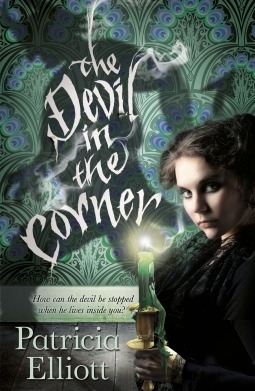
The Devil in the Corner

20728920 

Title: The Devil in the Corner
Author: Patricia Elliott
Series: N/A
Publisher: Hachette Children's Books
Publication Date: March 6 2014
Source: Netgalley

Goodreads Summary: A gorgeously Gothic historical tale.

 Penniless, and escaping the horrors of life as a governess to brutal households, Maud seeks refuge with the cousin-by-marriage she never knew. But Juliana quashes Maud's emerging friendships with the staff and locals - especially John, the artist commissioned to restore the sinister Doom in the local church. John, however, is smitten with Maud and makes every effort to woo her.

Maud, isolated and thwarted at every turn, continues to take the laudanum which was her only solace in London. Soon she becomes dependent on the drug - so is this the cause of her fresh anxieties? Or is someone - or something - plotting her demise?

Is the devil in the corner of the Doom a reality, or a figment of her imagination?
 

My Thoughts:  While I enjoyed reading this book, I thought it was very strange and confusing - which relates back to the fact that it is written in a Gothic style. 
     Gothic Style: The typical Gothic style, most notably employed in The Castle of Otranto and then later by Edgar Allan Poe, mixes elements of Romanticism, horror, and fiction together. The result is a novel which is dark, and mysterious, often with an unreliable narrator, and events which never fully explain themselves. An example of this is in Poe's The Fall of the House of Usher in which it is assumed that Madeleine rising from the grave was simply a figment of Roderick's imagination because of the poisonous fumes surrounding the house, and the dangers of incest, it is also assumed that many of the fantastical events in the story occur because of the narrator's unreliability. However, Poe never sets in stone if those are in fact the reasons for those events. Elliott used many of these same elements in Devil in the Corner in order to paint her Gothic tale.


WARNING: SPOILERS!


Beginnings: This is not a warm and fuzzy book. It's dark and the characters are twisted and confusing - they have many layers and the reader never fully understands them. The main character - Maud has had an awful life since her father died a few years ago. Employed as a governess she has worked at three different house holds where she encountered abusive and horrible children, and groping masters. She thinks she is a horrible person and in order to stop nightmares of the horrible things which have happened to her she drinks laudanum every night before bed. When she gets a letter from her step cousin inviting her to stay permanently at her house and keep her company, she is over joyed, believing that her horrible past is behind her. 
Juliana however is not what she seems - she is demanding, controlling and mean. Maud however feels indebted to her and takes care of her.
Enter John. John is the painter who has been called to restore a painting of the Last Judgment (The Doom) found in the church - Juliana is his patron. John and Maud fall in love, but he feels that he cannot support her as an artist and because of an embarrassing dinner party, John breaks off the relationship and returns to London. Maud feels like all the sunshine has left her life. It doesn't help that another girl in town - Edie, also loves John and actually receives letters from him.
Maud begins to run out of laudanum and because Juliana will give her no money resorts to stealing it from the drugstore. She goes to relieve Edie when her mother takes a fall and when searching for the drug stumbles upon arsenic and the miracle medicine that almost everyone in the village takes.

Death: Then, people start dying. First the lunatic who works at the manor and follows Maud. Next, the Butcher's son, who treats women like meat. As they die their pictures appear crudely drawn in charcoal on The Doom. Juliana gets worse, from thinking that she is dying, to actually dying. Many of the maids get dismissed until only a few are left. The remaining ones are frightened of Maud saying that at night she wanders the house. Maud does not know what they are talking about, and takes more laudanum in order to calm her nerves and drown out her sorrow. Then, Juliana dies. 


Guilt: Maud is accused of killing her cousin because she is the heir to the estate, the poison - arsenic. The strange thing is that although Maud never explicitly says she killed Juliana - she doesn't say she didn't either. She seems just as confused about it as everyone else is. One of the maids accuses her of using the recently found rat poison to kill Juliana and of drawing the pictures on The Doom. They lock her in her room - with the devil in the corner. Maud sees him clearly - a monster that sees who she truly is and knows of her wickedness. The next morning the police come and take Maud into custody to await her trial.

Trial: John finds out that Maud has been accused of Juliana's death - and because he is still very much in love with her finds the best detective he can to clear her charge. It is when they are investigating that the detective discovers large chunks of wallpaper have been torn off of the wall behind Juliana's bed. It appeared that when in distress Juliana would tear the wallpaper - the wallpaper which contains large amounts of arsenic. It is determined by the jury that the wallpaper was the cause of death - and not Maud. She is cleared, but she is still not sure. While in custody she was separated from her laudanum, which gave her head time to clear, and she can remember very little from the time of Juliana's death because of the power of the drug. 

Endings: Now that Maud is the owner of the estate and John has gotten a study job in London, he comes back for her. The novel ends with Maud running into John's arms.

Ambiguous Much? So, I read the entire book, and while I would love to believe that Maud didn't really kill all those people, I still don't know. Maud is an unreliable narrator, the reader cannot believe everything that Maud tells them because she is drugged and disturbed for most of the novel - she cannot think clearly and often has hallucinations. That's one of the reasons that I can't give this book more than three stars - I was super confused for most of it, and found the hallucinations quite disturbing. I think if someone was writing a report or doing a project on Gothic stories and how they have changed over time, I would definitely tell them to read this, but otherwise don't. While this book kept me reading it was more because I was hoping that everything would make sense in the end. I was hoping it would be like a detective novel where everything is figured out and explained in the end, and it wasn't.

Rating:

Tuesday, April 15, 2014

The Fall of Arthur: Unfinished Masterpiece

16075147
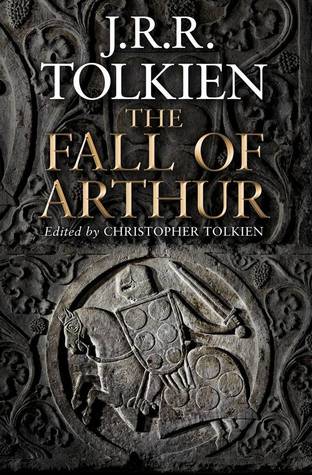
Title: The Fall of Arthur
Author: J.R.R. Tolkien
Date of Publication: 2013
Publisher: Houghton Mifflin Harcourt

What I have to say:

I have never read another book in which the words themselves were such a source of delight.

We always talk about how Tolkien was a linguist - and sure, he invented a pretty awesome language for the elves, and the writing in Lord of the Rings is wonderful, but - holy cow!!! The Fall of Arthur is amazing!!!

Listen to this:
"Guinever hiding   in the grey shadow 
watched and waited,   while the world faltered" (III.181-82).

And this:

Wolves were howling   on the wood's border;
the windy trees   wailed and trembled,
and wandering leaves   wild and homeless
drifted dying   in the deep hollows.
Dark lay the road   through dank valleys
among mounting hills   mist-encircled
to the walls of Wales   in the west frowning
brownfaced and bare.   To the black mountains
horsemen hastened,   on the houseless stones
no track leaving.   Tumbling waters
from the fells falling,   foaming in darkness,
they heard as they passed   to the hidden kingdom.
Night fell behind.   The noise of hooves
was lost in silence   in a land of shadow. (IV.1-14)  

I hope you enjoyed that as much as I did. And that is just a sample from Tolkien's narrative poem on the downfall of Camelot - his only venture into Arthurian legend according to the dust jacket, though, as someone pointed out on Goodreads, he also wrote this thing called Sir Gawain and the Green Knight. The poem is thoughtful, masterful, breathtaking, and, catastrophically, unfinished. Despite the comment from one of his friends that, "You simply must finish it!" this is another work that Tolkien never finished. The upside of that is that it's a quick read - only 57 pages, 70 if you count the notes on the text. And commentary by Christopher Tolkien on the larger context of the poem, both in Arthurian tradition and in Tolkien's writings in general, as well as on the evolution of the poem, follows the authorial text (I'm sure it's very interesting, but I didn't read it).

Here's what Goodreads has to say:

The world's first publication of a previously unknown work by J.R.R. Tolkien, which tells the extraordinary story of the final days of England’s legendary hero, King Arthur.

The Fall of Arthur recounts in verse the last campaign of King Arthur who, even as he stands at the threshold of Mirkwood, is summoned back to Britain by news of the treachery of Mordred. Already weakened in spirit by Guinevere's infidelity with the now-exiled Lancelot, Arthur must rouse his knights to battle one last time against Mordred's rebels and foreign mercenaries.

Powerful, passionate and filled with vivid imagery, The Fall of Arthur reveals Tolkien's gift for storytelling at its brilliant best. Originally composed by J.R.R. Tolkien in the 1930s, this work was set aside for The Hobbit and lay untouched for 80 years.

Now it has been edited for publication by Tolkien's son, Christopher, who contributes three illuminating essays that explore the literary world of King Arthur, reveal the deeper meaning of the verses and the painstaking work that his father applied to bring it to a finished form, and the intriguing links between The Fall of Arthur and his greatest creation, Middle-earth.


[Also, this book was a goodreads choice winner for poetry in 2013, because Tolkien is just so good that he can still win awards for his literature after being dead for 41 years.]

Thursday, April 10, 2014

Faelorehn by Jenna Elizabeth Johnson

Faelorehn

13612018 

Title: Faelorehn
Author: Jenna Elizabeth Johnson
Series: The Otherworld Trilogy (book one)
Publisher: Indie Ink
Publication Date: April 21 2012
Source: Netgalley

 Goodreads Summary: I never heard him come after me and even as I climbed the slope and stumbled onto our shaded back lawn, I didn’t look back. It was like the day the gnomes chased me all over again, but this time I was not escaping some horrible little creatures, I was fleeing from an incredibly good-looking guy who could very well understand me completely. I was either saving myself from that serial killer I always imagined lived down in the swamp, or I had finally gone over the deep end . . .

Meghan Elam has been strange her entire life: her eyes have this odd habit of changing color and she sees and hears things no one else does. When the visions and voices in her head start to get worse, she is convinced that her parents will want to drag her off to another psychiatrist. That is, until the mysterious Cade MacRoich shows up out of nowhere with an explanation of his own.

Cade brings her news of another realm where goblins and gnomes are the norm, a place where whispering spirits exist in the very earth, and a world where Meghan just might find the answers she has always sought.

My Thoughts: Lately in the world of Young Adult literature, paranormal has been a big thing, however, most authors don't pick a particular mythology to restrict their paranormalcy to, instead they utilize tons of aspects of many different myths and cultures to create their novel. This can be a little confusing when you have vampires and werewolves right along side kelpies and banshees. What I loved about Faelorehn was that Johnson picked on mythology and she stuck to it. She educated her readers through her novel, instead of picking paranormal creatures that her readers would already know. In that way she was able to completely construct her own novel and characters without worrying about creatures that already had connotations attached to them. This book was excellent and Johnson's incorporation of Celtic mythology was fantastic. 

Currently I am writing a novel which incorporates Celtic mythology and creatures. Because of that fact I really enjoyed how Johnson wrote the creatures into her story, and how Cade and Meghan had different names for them, such as gnomes vs. faelah. The reason I liked it was that Johnson didn't feel like she needed to dumb down the names of the creatures in order for her audience to understand, and I really appreciated that. 

So, on to what I thought about the plot . . . 


****SPOILERS****


Plot: Meghan Elam was found at the age of two wandering the streets of San Francisco alone and naked. For two years she bounced around the foster care system before being adopted by the Elams. She has five brothers, all of which are younger than her, which add a lot of color to her life. From the day she was found most people have stayed away from her because there is something "off" about her. Maybe it's the way that her eyes, which change color, are slightly too slanted, or that fact that she hears voices, and sees strange things watching her. She proclaims herself crazy, and often refers to how she has really gone off the deep end. That said, she does have friends, albeit they're the school outcasts, but they are still friends.
         Everything in her life changes when she wakes up from a dream to find that she has sleep walked into the swamp behind her family's house. She turns to go home when large black carcass like hounds surround her intent on tearing her apart. She is saved by a large white dog and a young man, who afterwards makes her think the encounter is a dream and takes her home. It's not until a week later that she learns it wasn't a dream and that the man's name is Cade MacRoich. He believes she, like him is a Faelorehn, one of the immortal fae from the Otherworld. It explains why she hears voices and gets attacked by terrifying creatures of death. 
       Throughout the next few months Meghan learns more about the Celtic Otherworld and is trained by Cade to defend herself against the demons. However just as Meghan starts to settle in to her new knowledge and life she is attacked by a giant raven - the symbol of the Morrigan, Celtic goddess of death. But that's not all, Meghan appears to have some from of telekinesis, and she's falling for Cade, hard.

I really loved the character of Fergus. I think it was because he wasn't just a dog, or Cade's weakness or something inferior. Instead he was Cade's equal and guide, canines play an important role in Celtic mythology and I was glad that Johnson utilized that in her novel.

One of my favorite scenes was just after Meghan arrived in the Otherworld. Immediately it is clear that the Otherworld is not fairyland. The goddess of death calls upon her creatures of darkness to destroy Meghan and they come, crawling out of the ground slowly approaching their victim. The best things about these creatures? The reader can't identify them as any specific monster, they're too grotesque. My favorite part about this scene is that Cade doesn't appear and fight off the creatures before they can reach Meghan. He doesn't appear in the nick of time to save the girl who is completely defenseless. Megan does not leave the situation Scot-free. The creatures reach her and begin to tear her apart, but even as they do so she doesn't lose her senses, she grabs the nearest rock she can reach and chucks it at the Morrigan hoping to break her concentration and thus her hold over the monsters. I loved how Johnson painted Meghan as an intelligent person who could still think logically under pressure. It's just as Meghan is losing consciousness that Cade finally arrives, Fergus in tow. And as the world goes black around her Meghan watches Cade transform. But, into what? I DON'T KNOW, BUT THE MORRIGAN IS AFRAID OF HIM! GAHHHHH!!!!! I REALLY WANT HIM TO BE CUCHULAINN BECAUSE THAT WOULD BE AWESOME!!!!!! Okay, calming down. So Meghan wakes up in a human hospital with a broken leg and severe bruising, but she's alive. That was another thing I really liked about this book, when Meghan gets injured she doesn't stay in the Otherworld, or even get healed by magic, instead she gets sent home, because some injuries are serious and can't just be healed in the blink of an eye. 
 
So, I would definitely recommend this book to anyone who likes their paranormal with a hint of organization, and I am super excited to read the next book in the series! Congratulations Johnson, you've got my stamp of approval! :)
 Rating:
 

Sunday, April 6, 2014

Kenneth Oppel's This Dark Endeavor

10860716 
Title: This Dark Endeavor
Author: Kenneth Oppel
Series: The Apprenticeship of Victor Frankenstein (#1)
Publisher: Simon & Schuster
Publication Date: 2011 

What Goodreads has to say:

Victor Frankenstein leads a charmed life. He and his twin brother, Konrad, and their beautiful cousin Elizabeth take lessons at home and spend their spare time fencing and horseback riding. Along with their friend Henry, they have explored all the hidden passageways and secret rooms of the palatial Frankenstein chateau. Except one.

The Dark Library contains ancient tomes written in strange languages and filled with forbidden knowledge. Their father makes them promise never to visit the library, but when Konrad becomes deathly ill, Victor knows he must find the book that contains the recipe for the legendary Elixir of Life.

The elixir needs only three ingredients. But impossible odds, dangerous alchemy and a bitter love triangle threaten their quest at every turn.

Victor knows he must not fail. Yet his success depends on how far he is willing to push the boundaries of nature, science and love—and how much he is willing to sacrifice.

What I have to say:

"We found the monster on a rocky ledge high above the lake. For three dark days my brother and I had tracked it through the maze of caves to its lair on the mountain's summit. And now we beheld it, curled atop its treasure, its pale fur and scales ablaze with moonlight."

After a long fight with the monster, the narrator and his identical twin brother succeed in killing it. As the monster dies, the narrator kneels down beside it.

"'Why,' I asked her. 'Why was it only me you attacked?'  
'Because it is you,' she whispered, ' who is the real monster.'
And with that, she died, leaving me more shaken than I could describe... I turned my gaze to the pile of treasure.
'We have more than can ever be spent,' my brother murmured.  
I looked at him. 'The treasure is mine alone.'"  
... Back and forth across the ledge we fought... before long I had smacked the sword from his hand and forced him to his knees. Even as he stared at me with my own face, and pleaded with me in my own voice, I plunged the sword into his heart and stole his life.  
I gave a sigh of utter relief and looked up at the moon, felt the cool May air caress my face.  
'Now I shall have all the riches in the world,' I said. 'And I am, at last, alone.'"
So begins This Dark Endeavor, Kenneth Oppel's young adult prequel to Mary Shelley's Frankenstein. But don't worry, the opening scene is only a play, put on by teenage Victor Frankenstein, his twin brother Konrad, their cousin Elizabeth, and the trio's close friend Henry Clerval. Clearly, though, not everything in the play is fictitious. In fact, looking back on this opening chapter after having read the whole book, I'm kind of getting goose-bumps. The play that Victor and his friends put on introduces several of the themes that run throughout the book:


1. Monster/Animal

2. Twins

3. Sharing "treasure"

4. Being alone


In listing the themes or undercurrents of the novel, I would only add one more to this list:


5. Science vs. Religion vs. Alchemy


That's not to say that these were the only themes of the book, but they were the main ones that I detected. I'd like to explore some of them in greater detail, because I think that the way the author sets up these themes and then has his characters interact with them is very interesting and well-thought-out. But first, I'd like to record some of my overall impressions of the book, as this is primarily a book review.


First of all, let me just say that I really loved this book. It had its faults (which I will get to in a second) but over all I found it extremely engaging, very well-written and at times thought-provoking, and wonderfully Gothic. In other words, the author delivered. Because Frankenstein itself is engaging, thought-provoking, and the most successful Gothic novel of all time, readers who pick up a prequel to Mary Shelley's classic would expect it to incorporate all of these things as well, though perhaps on a slightly smaller scale (as it is a YA novel). And that is just what Kenneth Oppel gives us.

There were many times when I could not put this book down. I had to read just one more chapter, not only to find out what happened next, but also because the writing was so fun and the main character so interesting. It's been a while since I've read anything so engaging, especially towards the end. It was super intense. Also, a word of caution, this book gets rather violent in its final chapters (it is the prequel to Frankenstein, after all). It was pretty bloody and a little sickening. Also riveting.

At several points in the novel, I was surprised by the deep questions the story was engaging with, as well as by the way that the author dealt with these questions. For example, I was not expecting to find in a YA thriller a deep discussion on Atheism and religion. Victor's family is very liberal and thus he and his parents are atheists; but his cousin Elizabeth was raised by nuns and is a devout Catholic. Victor's parents never discourage Elizabeth from practicing her religion, even going so far as to make sure that she has a ride to Mass whenever she needs it. As the story progresses and the lives of all the characters darken, many of them begin to find out just how far their beliefs go, and if the stance they have taken on the subject of religion is in fact the right one. The author never directly answers this question, but definitely prompts readers to think about it through the lens of the story.

Finally, this novel was CREEPY. And by that, I don't mean that it kept me up at night imagining things coming at me out of the darkness, or that it gave me nightmares. I mean that it was deliciously creepy, in true Gothic style. There is a hidden library in the Frankenstein family mansion, containing forbidden books on alchemy and magic. Elizabeth sleepwalks at night, but she never remembers it in the morning. The forest nearby houses fierce animals like wolves and vultures, and there are caves beneath the lake that contain monstrous fish thought by many to be extinct. You get the idea. This is a book that makes you shiver, but in such a way that you want to shiver again.

Another thing I loved about this book was that it is indeed a prequel - and a very careful and thoughtful prequel at that. Kenneth Oppel has obviously done his homework and, as far as I can tell, thought a great deal about the original novel by Mary Shelley. He sets everything up perfectly, and adds new layers to the story of Frankenstein. One example, and something that I particularly enjoyed about this story, is the protagonist: Victor Frankenstein. He is a very likeable character (at least in my opinion) and easy to empathize with, but he is also deeply flawed in all of the ways that Mary Shelley's protagonist is flawed: he's rather arrogant, so passionate that he sometimes frightens Elizabeth, and dead-set on accomplishing something once he's fixed his mind to it, whether or not it's a good idea.

That being said (and I think this may be my one criticism of the novel) there were a few moments in the book that were so obviously hearkening forward to Frankenstein that I almost laughed aloud. Some examples are: a street named "Wollstonecraft Alley;" a metaphor around the middle of the book that makes a comparison with a ship locked in ice; and Elizabeth's dream about her wedding day, in which a strange voice tells her, "I will be with you on your wedding night." Though that last one is kind of interesting, as the voice could actually belong to a few different characters - Victor, Konrad, and of course the monster, included. These moments in the book were really the only places where I felt that the author might be straining a little too hard in order to build a connection with Frankenstein. I guess it felt somewhat forced. But, I must admit that I also kind of enjoyed these moments. They were nods to people who had read Frankenstein, and it was fun to "pick them out" even if that didn't require much effort. Maybe my problem is that these nods made it so that This Dark Endeavor was not a self-contained book. And to the objection that a prequel is never self-contained (if anyone wants to make that objection) I point to The Hobbit. The Hobbit is self-contained because you don't have to read The Lord of the Rings trilogy in order to understand The Hobbit. I've never heard of anyone just reading The Hobbit and never going on to the trilogy, and certainly you will have a richer, deeper experience if you read all of the books; but you can read just The Hobbit and not have any confusion resulting from not having read the trilogy beforehand. Part of that is undoubtedly because Tolkien wrote The Hobbit first - his original readers (as well as himself) didn't have the trilogy in front of them: they only had the "prequel" which wasn't even a prequel at the time, but a stand alone novel. And I promise this is not a review about The Hobbit, so I'll get back to This Dark Endeavor. My point is that, when you insert things into your book which readers will only understand and/or enjoy if they've read another book, you limit your audience and, I think, weaken your own story - because you're relying on that other story to make your story more enjoyable. But this is a minor criticism, and it didn't prevent me from enjoying the story.


And now that I have given you my general impressions, I'd like to get back to the opening scene of the story and give you a taste for how it introduces the major themes of the novel.

1. Monster/Animal

This first chapter is titled, "Monster," which gave me pause for a moment. Thinking back on it, it gives me even more pause. Who is the monster that the title refers to? Just reading the title on its own, before plunging into the actual text, I thought of Frankenstein's monster, and I assume that is primarily what Oppel meant his readers to think of. But once we get into the chapter itself, things become more complicated. Obviously, there is the fictional monster in the play, who the main character and his brother must slay in order to free the town and break the enchantment. I will call this monster #2, as monster #1 is the original monster created by Victor Frankenstein in Mary Shelley's novel. But then, Elizabeth (Victor's cousin) wears the costume of the monster and acts as the monster in the play, so could she be the monster referred to in the title (monster #3)? Then, of course, there is the possibility that Victor himself is the monster, since the play monster tells him so with her dying breath ("It is you who are the real monster"). And what makes this question even more interesting is that it seems equally possible for all of these candidates to be the monster based on supporting evidence from the text. I'll skip over monsters #1 and #2, because those two are kind of obvious, and move on to Elizabeth.

Elizabeth is beautiful, devoutly religious, and often gentle and kind. But she has a dark side.... (cue dramatic music). As already mentioned, she sleepwalks. She also has a resolve and a passion fully capable of matching Victor's. When Victor, Henry, and Elizabeth venture into the Sturmwald forest and are attacked by vultures, Elizabeth bites one in defense. At another point, she helps Victor rip open an animal and search through its organs. In short, Victor's claim that his twin brother, Konrad, sees Elizabeth's angel, but he sees her animal, seems well justified.

But the obvious candidate for monster is Victor himself. Probably we do not even need to read This Dark Endeavor to know that; Frankenstein is enough. But This Dark Endeavor is full of evidence, nonetheless. Despite his deep love for his brother, Victor is insanely jealous of Konrad, and willing to go to great lengths to prove that he is at least the equal of his twin. Also, despite his brotherly love, he deceives and steals from Konrad. When Elizabeth writes a note to Konrad, Victor intercepts it and doesn't tell his brother. When Elizabeth meets Victor in the dark and thinks that he is Konrad, Victor does not enlighten her. Besides this, there are the character flaws I have already briefly mentioned above. He is proud, even arrogant, with a desperate need, that manifests itself repeatedly, to do things on his own in order to prove something to someone. Also he is driven by an almost demonic passion. He completely disregards his father's orders over and over again, even breaking the laws of the city in order to succeed in his "dark endeavor."

Maybe the title of "monster" does not belong to one character alone. There need not be only one monster whom we call the monster; it is truer and far more interesting to see each individual character as "monstrous" or animalistic in their own way. The book does not contain one sole, definitive monster, but several.

Anyway, I hope my discussion of this topic has given you a taste for how delightfully complex and multi-faceted this book is. Also, it's a lot of fun. So if you're looking for a good read, go ahead and pick it up. Let me know what you think.

Friday, March 28, 2014

Talus and the Frozen King or Sherlock Holmes Meets the Iron Age

Talus and the Frozen King

https://d202m5krfqbpi5.cloudfront.net/books/1378705804l/18143948.jpg 

Title: Talus and the Frozen King
Author: Graham Edwards
Series: N/A
Publisher: Rebellion
Publication Date: March 25 2014
Source: Netgalley 

Goodreads Summary: Meet Talus-the world's first detective.

A dead warrior king frozen in winter ice. Six grieving sons, each with his own reason to kill. Two weary travelers caught up in a web of suspicion and deceit.

In a distant time long before our own, wandering bard Talus and his companion Bran journey to the island realm of Creyak, where the king has been murdered. From clues scattered among the island's mysterious barrows and stone circles, they begin their search for his killer. But do the answers lie in this world or the next?

Nobody is above suspicion, from the king's heir to the tribal shaman, from the servant woman steeped in herb-lore to the visiting warlord whose unexpected arrival throws the whole tribe into confusion. And when death strikes again, Talus and Bran realize nothing is what it seems. Creyak is place of secrets and spirits, mystery and myth. It will take a clever man indeed to unravel the truth. The kind of man this ancient world has not seen before.
 

My Thoughts: When I started this book I couldn't remember why I had requested it in the first place because it had been on my reading list for so long. So, I started the novel without even knowing what genre it was, and funny enough even after reading it I'm still not sure what the genre was . . . but anyway, I had an extremely open mind to this book. 
Within the first chapter it became very clear to me that Talus was Sherlock Holmes. I mean, I guess I should have guessed there would be parallels since the subtitle of the book is "Introducing the world's first detective" but I really wasn't prepared for just how Holmes like Talus would be. As an avid fan of Sir Arthur Conan Doyle I have read all of the Sherlock Holmes stories and novels, and I can tell right away when my favorite detective is being described. Talus is tall and thin, he is often described as bony, but he is also inhumanly strong. Throughout the novel the story is told from Talus's point of view as such there are often references to the buzzing in Talus's head and how he sees so much more than everyone else. He never rests and is constantly jumping from clue to clue without informing his colleagues. He only has one friend - Bran, who most of the time can't stand him, he has an undeniable sense of authority about him, and he has a hard time understanding human feelings. Now I would like to describe Holmes. Holmes is tall and thin but unusually strong. His brain is never still, causing him to use opium when not on a case in order to slow his racing mind. Holmes constantly solves cases quickly, but then stays around for a while longer in order to gain the evidence to prove the verdict to the police or victims. Holmes only has one friend - Watson, who has to takes breaks from Holmes stunning and obnoxious intellect. There is a reason the police treat Holmes as a superior - he can speak quietly in a crowded room and still be heard because of the power and authority which he possesses. And have you seen Sherlock? Man does he have a hard time understanding emotions! Have I convinced you of the similarities yet?
Having said that, Bran is akin to Watson. Both the "gunmen" for their intellectual friends, these characters often have no idea what is going on, but have incredible faith in the abilities of their
"besties". Bran, like Watson, will do anything that Talus asks of him, although he often doesn't know why. At the end of the day both of these characters would rather be near their "bestie" than anywhere else. Wow Edwards, are you much of a Sherlock Holmes fan?

Now, to the plot. This story had plenty of twists and turns and I honestly didn't know who the killer was until Edwards revealed it. Wow, yeah I totally didn't see it coming. So congrats on writing a complicated story that kept it's readers on their toes. Anywhoooo . . . the story starts with Bran waking from a nightmare. Two years ago he failed to save his wife from the sea because of falling stars, one of which destroyed Keyli, and another which destroyed Bran's right arm. Bran and Talus are following the northlight; a magical green light which appears in the sky filled with spirits. There is a legend that if a man follows the light to the bitter north he will find those whom he loved and lost and have a choice to either bring them back, or join them. Bran seeks after this light to bring back Keyli, and Talus because of reasons unknown and his intense curiosity.
The action begins with Bran and Talus on a cliff which over looks a village. They're awakened by the sound of inhuman wailing. Because Talus is inexplicably drawn to strange occurrences he bounds down to the village to see if they can help. They arrive to find the king dead and frozen stiff as a board, oh, and he's naked. Within moments of examining the dead king Talus proclaims he was murdered. Talus and Bran are commanded to stay at the village until the murder case is solved, and of course, Talus takes it upon himself to solve it. 
The story that follows is intense and rather violent. It's the story of an over controlling father and the results of his iron rule. This story questions if an iron peace is really peace at all. 

Rating: 
Why only three trees? I only gave this book three trees because I'm pretty sure I only enjoyed it as much as I did because of the similarities between Holmes and Talus. I kept reading in order to see just how like Holmes he could be, and not really for the actual story. That said, it was still a good original storyline.

Sunday, February 16, 2014

Keep Calm and Love On: Les Miserables

Victor Hugo's Les Miserables

24280
Title: Les Miserables
Author: Victor Hugo
Original Publication Date: 1862
Original Language: French
Edition: Unabridged translation by Lee Fahnestock and Norman Afee, based on the classic C.E. Wilbour translation
Publisher: Penguin Books, 1987

Everyone should read this book. But few do. And the reason is this: the book is 1463 pages long, and the storyline often pursues seemingly irrelevant threads that bear no apparent relation to the rest of the story. But, for the faithful, persistent reader who makes it all the way to the end, it is a wonderful and incredibly moving experience. (And, I would argue, each of the apparently unrelated tangents serve to deepen our understanding of the novel's world and its characters.)

But because I feel that a complete review of Les Miserables would have to touch on each different thread of the story and thus be ultimately impossible to write, I have chosen to focus on a single thread. This is the one theme which I found running through the whole book and unifying all of the novel's diverse characters and events: love.

"To love or to have loved, that is enough. Ask nothing further. There is no other pearl to be found in the dark folds of life. To love is a consummation" (1382).
If I could choose one statement from the book to sum up all of its characters and their various stories, I would choose this one. Many of Hugo's characters lead sad, lonely lives, but almost all of them have someone that they love, and this love is the one bright spot in their existence. In many cases, it is this love which redeems them and makes each individual character, if only for one moment, a hero.


Fantine: 

Obviously, Fantine's life sucks. After her (loser) boyfriend abandons her, Fantine gives birth to his child and sells everything she owns (literally) to support that child. She starts by working at a factory, loses her job, sells her possessions, sells her teeth and her hair, and ends by being a prostitute. She starves, goes slightly crazy, gets sick, and dies. Her life was black, cold, and hopeless. But she loved. She loved Tholomyes (the father of her child), and she loved her daughter, Cosette. And these were the bright spots in her existence. When she lies dying in the hospital, under the care of Sister Simplice and the other nuns, Fantine speaks almost constantly of Cosette, and when she does, her face lights up and she is happy. She feels sure that, if she can just have Cosette beside her, she will recover her health. And when she hears that her daughter is coming, Fantine exclaims, "Here at last I see happiness near me" (203).


Jean Valjean:

Jean Valjean also loves Cosette. She makes his whole life wonderful and worth the living. Before she comes into his life, he has made the decision to be a good man, and is fulfilling this resolution very well. But his life is not particularly happy. He is lonely; he has no family and, though his people admire him as the Mayor, he has no real friends. But with Cosette, light and joy enter into his life:
To meet was to find one another. In that mysterious moment when their hands touched, they were welded together. When their two souls saw each other, they recognized mutual need, and they embraced.
...The coming of this man and his participation in this child's destiny had been the coming of God.
...Who can tell whether Jean Valjean was on the verge of discouragement and falling back on evil ways? He loved, and he grew strong again. Alas, he was as frail as Cosette. He protected her, and she gave him strength. Thanks to him, she could walk upright in life; thanks to her, he could persist in virtue. He was this child's support, and she was his prop and staff. Oh, divine unfathomable mystery of Destiny's compensations. (436-39)
This beautiful passage shows how Cosette's coming illuminates and redeems Valjean's life. Without her, he may have fallen back on his old ways and become once more an embittered criminal. But this does not happen, because Cosette happens instead. For both Valjean and Cosette, coming together is their saving grace. Their love for each other is what makes life beautiful and glorious.


Eponine:

Like Fantine, Eponine has it rough; her father is a scoundrel who seems to care nothing for his children, her mother cares but is also a scoundrel, and the family lives in abject poverty. As a result, Eponine is poor, uneducated, and devoid of morality. She has never been taught virtue and right, and so there seems to be no hope for her to become a better person than her parents are. There is no light in Eponine's life, until Marius comes. Marius brings light, and this light illuminates Eponine's dark existence, throwing its beams into every corner. She becomes beautiful, kind, brave, and virtuous. She helps a poor, despairing old man by watering his whole garden in the middle of the night; she leads Marius to Cosette even though it is contrary to her own happiness, and, once she had found Cosette's house, she guards it against her father and his band of thieves. And, of course, she takes the bullet directed at Marius. Now, despite all of this, Eponine is not perfect. She is still poor and uneducated, and she still entices Marius to the barricade in the hope that they will die together, but, undoubtedly, her life and her character have improved vastly as a result of her love for Marius. Her love is the light in her life which, once again, illuminates and redeems her existence.

Grantaire:

Grantaire is introduced as a craven, skeptical drunkard ("a rover, a gambler, a libertine, and often drunk" [657]). He hangs out with the Friends of the ABC but believes in none of the things they stand for. His life is meaningless, except for one thing: Enjolras. The narrator tells us, "Grantaire admired, loved, and venerated Enjolras" (658). Their relationship is described as follows, in one of my favorite passages from the book:

Still, this skeptic [Grantaire] had fanatacism. This fanaticism was not for an idea, nor a dogma, nor an art, nor a science; it was for a man: Enjolras. Grantaire admired, loved, and venerated Enjolras. To whom did this anarchical doubter ally himself in this phalanx of absolute minds? To the most absolute. In what way did Enjolras subjugate him? By ideas? No. Through character. A phenomenon often seen. A skeptic adhering to a believer is as simple as the law of complementary colors. What we lack attracts us. Nobody loves the light like a blind man. The dwarf adores the drum major. The toad is always looking up at the sky. Why? To see the bird fly. Grantaire, crawling with doubt, loved to see faith soaring in Enjolras. He needed Enjolras. Without understanding it clearly, and without trying to explain it to himself, that chaste, healthy, firm, direct, hard, honest nature charmed him. Instinctively, he admired his opposite. His soft, wavering, disjointed, diseased, deformed ideas hitched onto Enjolras as a backbone. His moral spine leaned on that firmness. Beside Enjolras Grantaire became somebody again. On his own, he was actually composed of two apparently incompatible elements. He was ironic and cordial. His indifference was loving. His mind dispensed with belief, yet his heart could not dispense with friendship. A thorough contradiction; for an affection is a conviction. This was his nature. There are men who seem born to be the opposite, the reverse, the counterpart. They are Pollux, Patroclus, Nisus, Eudamidas, Ephestion, Pechméja. They live only on condition of leaning on another; their names are sequels, only written preceded by the conjunction "and"; their existence is not their own; it is the other side of a destiny not their own. Grantaire was one of these men. He was the reverse of Enjolras.

We might almost say that affinities begin with the letters of the alphabet. In the series O and P are inseparable. You can, as you choose, pronounce O and P, or Orestes and Pylades.

Grantaire, a true satellite of Enjolras, lived in this circle of young people; he existed within it; he took pleasure only in it; he followed them everywhere. His delight was to see these forms coming and going in the haze of wine. He was tolerated for his good humor.

Enjolras, being a believer, disdained this skeptic, and being sober, scorned this drunkard. He granted him a bit of haughty pity. Grantaire was an unaccepted Pylades. Always treated rudely by Enjolras, harshly repelled, rejected, yet returning, he said of Enjolras, "What a fine statue!" (657-59)
Towards the end of this passage, Hugo makes several references to Greek mythology to illustrate his point. At the end of the first paragraph, the names mentioned (as you can probably gather) are names which always appear in conjunction with another name. For example, Castor and Pollux were two brothers who loved each other deeply and who always appear together. In the second paragraph, the Orestes and Pylades referenced were a pair of companions from Greek mythology, noted for their deep friendship and love for each other.

Basically, Grantaire's love for Enjolras is what makes his life worth living and what brings meaning to his existence. And then....


*****************SPOILER ALERT*******************


Everyone at the barricade DIES! Well, OK, except for two people. But you should really know that if you've ever seen the play, watched the movie, or even heard about it.


***************BIGGER SPOILER ALERT******************


In death, Grantaire finally achieves heroism through his love for Enjolras. With the barricade invaded and all of its defenders fallen, Enjolras stands in the upper room of the wine shop surrounded by soldiers ready to shoot him. Throwing away his gun, he tells them defiantly, "Shoot me" (1250). At this moment, Grantaire, who, in a mood of dejection brought on by Enjolras' disdain for him, drunk himself into unconsciousness a while ago and has been sleeping under the table, wakes up. He takes in the situation with one glance, and then:
Relegated as he was to a corner and as though sheltered behind the billiard table, the soldiers, their eyes fixed upon Enjolras, had not even noticed Grantaire, and the sergeant was preparing to repeat the order: "Take aim!" when suddenly they heard a powerful voice cry out beside them, "Vive la République! Count me in."

Grantaire was on his feet. 
The immense glare of the whole combat he had missed and in which he had not been, appeared in the flashing eye of the transfigured drunkard.

He repeated, "Vive la République!" crossed the room firmly, and took his place in front of the muskets beside Enjolras.

"Two at one shot," he said.

And, turning toward Enjolras gently, he said to him, "Will you permit it?"

Enjolras shook his hand with a smile.

The smile was not finished before the report was heard.

Enjolras, pierced by eight bullets, remained backed up against the wall as if the bullets had nailed him there. Except that his head was tilted.

Grantaire, struck down, collapsed at his feet. (1252)
How symbolic and poetic that Enjolras, the believing idealist, dies standing up straight, while Grantaire, the depraved drunkard who believes in nothing - except for Enjolras - collapses at the feet of the man he has worshiped. And yet, in this moment, Grantaire ceases to be a depraved drunkard. He is a hero who believes in something enough to die for it. And despite his cries of, "Vive la Republique," the thing he believes in is not the Republic; it is Enjolras. Through his love, Grantaire is transformed and redeemed. He has found the pearl in the dark folds of life.

And so, as each of these characters struggle along in the dark, cold, and barren tunnel of their life, they discover the truth which Jean Valjean voices in the final pages of the novel, "There is scarcely anything else in the world but that: to love one another" (1461). Or, as Marius writes to Cosette, "If no one loved, the sun would go out" (935). The characters of Les Miserables love fiercely, devotedly, and faithfully, amid all their pain and suffering. And their love redeems them, because, "to love another person is to see the face of God." Through their love, Fantine, Valjean, Eponine, Grantaire, and all of the other characters who love, find the doorway to God.