Showing posts with label Victor Hugo. Show all posts

Tuesday, November 25, 2014

Musings on Thanksgiving (with special appearances by C.S. Lewis, Victor Hugo, Thorin Oakenshield, and William Shakespeare)

(Wouldn't it be cool if we could change the background of this blog to match the seasons? Yeah, I don't know how to do that. Then again, the Wood between the Worlds probably doesn't have seasons. Anyway, here is a picture that looks like it could have been taken in the Wood between the Worlds in autumn, you know, if the Wood had an autumn.)
The weather is turning colder, the trees losing their leaves, and the stores displaying Christmas merchandise - which must mean that Thanksgiving is upon us.

I have nothing against listening to Christmas music once November hits, but let's make sure we don't rush over Thanksgiving in our excitement for Christmas to come; this holiday deserves its own time in the spotlight.

What's Thanksgiving about? Pilgrims and Indians? The Mayflower? The founding of America? Maybe, but if we want to find the true heart of Thanksgiving, all we need to do is remember the name of this holiday. Giving thanks is a sweet, joyous, and plentiful harvest in and of itself. C. S. Lewis, in Reflections on the Psalms, wrote:

“I think we delight to praise what we enjoy because the praise not merely expresses but completes the enjoyment; it is its appointed consummation. It is not out of compliment that lovers keep on telling one another how beautiful they are; the delight is incomplete till it is expressed. It is frustrating to have discovered a new author and not to be able to tell anyone how good he is; to come suddenly, at the turn of the road, upon some mountain valley of unexpected grandeur and then to have to keep silent because the people with you care for it no more than for a tin can in the ditch; to hear a good joke and find no one to share it with. . . . The Scotch catechism says that man’s chief end is ‘to glorify God and enjoy Him forever.’ But we shall then know that these are the same thing. Fully to enjoy is to glorify. In commanding us to glorify Him, God is inviting us to enjoy Him.”

Are you ever struck by the incredible beauty of this world? Now is the time to express your delight, wonder, and gratitude for the glorious things around you. And our gratitude shouldn't be confined to the subject of the beauty of nature; there are so many things to be grateful for that it's staggering. Even in our darkest moments, there is something amazingly beautiful or wonderful or helpful for which we can express thanks. And this thanksgiving shouldn't be confined to Thanksgiving. We can express gratitude all year long. But this is the time to focus on our gratitude and reflect upon it. If you're unsure of how to express your gratitude and to whom, take a cue from the words of Victor Hugo:

"To give thanks in solitude is enough. Thanksgiving has wings and goes where it must go. Your prayer knows much more about it than you do."

Whether its in prayer to God, in conversation to your friends or family, or in complete solitude in your journal or private thoughts, find some time to give thanks this Thanksgiving.  

But also find some time to enjoy good food, because that too is an important part of this holiday, and, after all, as Thorin says to Bilbo in The Hobbit:


"If more of us valued food and cheer and song above hoarded gold, it would be a merrier world."

So from the depths of my heart I truly hope you have a wonderful Thanksgiving and find both something to be thankful for and some food to enjoy. And I pray, with William Shakespeare:
 

"O Lord, that lends me life, lend me a heart replete with thankfulness."
                                      
(Henry VI, Part II)


Saturday, August 30, 2014

Les Miserables: The Original French Concept Album


Most people don't know that the musical Les Misérables was originally going to be in French. In fact, the writers, Alain Boublil and Claude-Michel Schönberg (both of whom are French) created an entire concept album in French before the producer Cameron Mackintosh asked them to turn it into a musical in the English language. And the product of that conversation is the musical we know today as Les Misérables, one of the most popular and longest running musicals in the history of theatre.

But the original French concept album still exists, and is very interesting as a prototype; many of the melodies from the current musical can be found in the concept album, though often attached to different lyrics and occurring at different moments in the plot. Some of the lyrics are also the same (though of course, in French rather than English). But there is also much that is different. The story itself varies in places from the current musical, with some parts left out and others added or changed. In many ways, the concept album follows the book more closely than the current musical does, but there are a few places where it deviates more from the book than does the current musical. There are moments in the concept album that send chills down your spine, but there are also moments that disappoint.

For example, the song that takes the place of "Castle on a Cloud," entitled "My Prince is on the Way," is absolutely beautiful and in some ways preferable to the current one, and the song that introduces us to M. Thenardier, "The Inkeeper's Motto," is, unlike "Master of the House," entirely appropriate. "À la Volonté du Peuple" (translated as "To the Will of the People"), replaces "Do You Hear the People Sing" with the same melody and more poetic lyrics. One scene in the concept album that I definitely prefer to the parallel scene in the current musical is Gavroche's death. But the song that takes the place of the current "Red and Black" is rather disappointing (it's just Marius soloing), and while the song that Eponine sings instead of "On My Own" is lovely, it doesn't hold a candle to the current showstopper.

I would like to do a little analysis of the concept album, because, while I still prefer the current version of Les Misérables, the concept album is very thoughtful and well-crafted. At the end of this post I'll share a link to the full text of the concept album (in French with a pretty spot-on English translation beside it) and another link to the music. Alors.

The second track in the concept album is titled, "L'Air de la Misére," or "The Air of Misery," and is sung by Fantine to the tune of "Come to Me" and "On My Own":

La misère n’est mere de personne
la misère est pourtant soeur des hommes
mais personne sur terre n’en veux pour fille
comme bâtarde née dans un cachot de la Bastille
La misère enfante la détresse
bien des vices et toutes les faiblesses
la misére lâche la bête en l’homme
et la mésange alors en chienne errante se tranforme

Then, in the final scene of the musical, entitled "Epilogue: La Lumière," or "Epilogue: The Light," Jean Valjean sings a different set of lyrics to the same tune (this tune is also utilized in the final scene of the current musical, by the way).

La lumière est dans le coeur des hommes 
mais s’épuise de brûler pour personne 
aimez-vous pour vaincre les ténèbres 
tant qu’il y aura partout 
orgueil, ignorance et misère
La lumière, au matin de justice, 
puisse enfin décapiter nos vices 
dans un monde où Dieu pourrait se plaire 
s’il décidait un jour de redescendre sur la terre.

OK, so I know you probably don't speak French (unless you do), but even so, you can probably tell that the two songs are echoing each other significantly. Both songs have the same melody and the same structure, and they use many of the same words and sentence structures. Let me give you an English translation so you can see the similarities more clearly. Here is Fantine's "Air of Misery":

Misery is the mother of no one
Misery is nevertheless sister of men
But no one on earth wants for a daughter
A bastard born in a dungeon of the Bastille 
Misery begets distress [or misery]
Plenty of vices and all weaknesses
Misery looses the beast in man
And the little bird then into a stray dog transforms.

Pretty bleak. But here is Jean Valjean's rewriting of Fantine's ballad:

The light is in the heart of men
But it will stop burning for no one 
Love each other to vanquish the shadows
As long as there is everywhere
Pride, ignorance and misery
The light, on the morning of justice,
Can finally decapitate our vices 
In a world where God could be pleased
If He decided one day to redescend to the earth.

You can see the echoes of Fantine's ballad in the first two lines of Valjean's song: "The light is in the heart of men / But it will stop burning for no one," echoes Fantine's "Misery is the mother of no one / Misery is nevertheless sister of men." Both singers take a subject - Misery or Light - and assign it to the human race, using the words "men" ("les hommes"), or "no one" ("personne"), at the end of each sentence. Moreover, both Fantine and Valjean refer to the vices of men, but while Fantine speaks only of their birth and existence in the world, Valjean reveals that love will one day destroy the vices created by misery. Fantine ends her song by lamenting man's transformation into a beast, but Valjean ends his song with the hope that man can someday transform into a more perfect and God-like being. Fantine's song reflects the uttermost depths of squalor and misery, but Valjean's song comes at the end of his life reflecting love, peace, and transcendence. As I read and listened to Valjean's final revelation, I couldn't help but think of my favorite quote from the novel Les Misérables: "To love or to have loved, that is enough. Ask nothing further. There is no other pearl to be found in the dark folds of life. To love is a consummation" (Hugo 1382). I find this quote echoed nicely in Valjean's song about "The Light."

If you're still here and haven't yet revolted over the length of this post and all the French text in it, I'd like to share one more song from the concept album with you. Here is (slightly shortened) the French text of "To the Will of the People," sung to the tune of "Do You Hear the People Sing" - side by side with an English translation:
À la volonté du peuple
Et à la santé du progrès
Remplis ton coeur d’un vin rebelle
Et à demain, ami fidèle
Nous voulons faire la lumière
Malgrè le masque de la nuit
Pour illuminer notre terre
Et changer la vie.  
À la volonté du people Je fais don de ma volonté
S’il faut mourir pour elle
Moi, je veux être le premier
Le premier nom gravé au marbre du monument d’espoir. 
À la volonté du peuple
Et à la santé du progrès
Remplis ton coeur d’un vin rebelle
Et à demain, ami fidèle
Nous voulons faire la lumière
Malgré le masque de la nuit
Pour illuminer notre terre
Et changer la vie.
To the will of the people
And to the health of progress
Refill your heart with a rebellious wine
And tomorrow, faithful friend
We want to make a light
Despite the mask of the night
To illuminate our land
And to change our lives.
To the will of the people I volunteer myself.
If it is necessary to die for her,
Me, I want to be the first
The first name carved on the marble of the monument of hope.
To the will of the people
And to the health of progress
Refill your heart with a rebellious wine
And tomorrow, faithful friend
We want to make a light
Despite the mask of the night
To illuminate our land
And to change our lives.


Well, I don't really have anything to say after that. If you want to check out the full text of the French concept album (plus an English translation) you can go to this website: http://www.placedauphine.net/translations/ofc.html

Then, if you'd like to hear the full French concept album, you can head over to this playlist on YouTube: http://www.youtube.com/playlist?list=PLE4A332CE9F807D86

If you'd like to read more of my thoughts on Les Misérables and you haven't yet read my review of the novel by Victor Hugo, you can check that out here: http://woodbtwntheworlds.blogspot.com/2014/02/keep-calm-and-love-on-les-miserables.html

Until tomorrow. Adieu.

Sunday, February 16, 2014

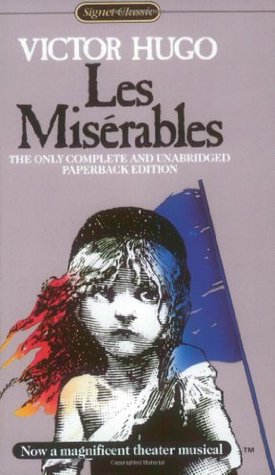
Keep Calm and Love On: Les Miserables

Victor Hugo's Les Miserables

24280
Title: Les Miserables
Author: Victor Hugo
Original Publication Date: 1862
Original Language: French
Edition: Unabridged translation by Lee Fahnestock and Norman Afee, based on the classic C.E. Wilbour translation
Publisher: Penguin Books, 1987

Everyone should read this book. But few do. And the reason is this: the book is 1463 pages long, and the storyline often pursues seemingly irrelevant threads that bear no apparent relation to the rest of the story. But, for the faithful, persistent reader who makes it all the way to the end, it is a wonderful and incredibly moving experience. (And, I would argue, each of the apparently unrelated tangents serve to deepen our understanding of the novel's world and its characters.)

But because I feel that a complete review of Les Miserables would have to touch on each different thread of the story and thus be ultimately impossible to write, I have chosen to focus on a single thread. This is the one theme which I found running through the whole book and unifying all of the novel's diverse characters and events: love.

"To love or to have loved, that is enough. Ask nothing further. There is no other pearl to be found in the dark folds of life. To love is a consummation" (1382).
If I could choose one statement from the book to sum up all of its characters and their various stories, I would choose this one. Many of Hugo's characters lead sad, lonely lives, but almost all of them have someone that they love, and this love is the one bright spot in their existence. In many cases, it is this love which redeems them and makes each individual character, if only for one moment, a hero.


Fantine: 

Obviously, Fantine's life sucks. After her (loser) boyfriend abandons her, Fantine gives birth to his child and sells everything she owns (literally) to support that child. She starts by working at a factory, loses her job, sells her possessions, sells her teeth and her hair, and ends by being a prostitute. She starves, goes slightly crazy, gets sick, and dies. Her life was black, cold, and hopeless. But she loved. She loved Tholomyes (the father of her child), and she loved her daughter, Cosette. And these were the bright spots in her existence. When she lies dying in the hospital, under the care of Sister Simplice and the other nuns, Fantine speaks almost constantly of Cosette, and when she does, her face lights up and she is happy. She feels sure that, if she can just have Cosette beside her, she will recover her health. And when she hears that her daughter is coming, Fantine exclaims, "Here at last I see happiness near me" (203).


Jean Valjean:

Jean Valjean also loves Cosette. She makes his whole life wonderful and worth the living. Before she comes into his life, he has made the decision to be a good man, and is fulfilling this resolution very well. But his life is not particularly happy. He is lonely; he has no family and, though his people admire him as the Mayor, he has no real friends. But with Cosette, light and joy enter into his life:
To meet was to find one another. In that mysterious moment when their hands touched, they were welded together. When their two souls saw each other, they recognized mutual need, and they embraced.
...The coming of this man and his participation in this child's destiny had been the coming of God.
...Who can tell whether Jean Valjean was on the verge of discouragement and falling back on evil ways? He loved, and he grew strong again. Alas, he was as frail as Cosette. He protected her, and she gave him strength. Thanks to him, she could walk upright in life; thanks to her, he could persist in virtue. He was this child's support, and she was his prop and staff. Oh, divine unfathomable mystery of Destiny's compensations. (436-39)
This beautiful passage shows how Cosette's coming illuminates and redeems Valjean's life. Without her, he may have fallen back on his old ways and become once more an embittered criminal. But this does not happen, because Cosette happens instead. For both Valjean and Cosette, coming together is their saving grace. Their love for each other is what makes life beautiful and glorious.


Eponine:

Like Fantine, Eponine has it rough; her father is a scoundrel who seems to care nothing for his children, her mother cares but is also a scoundrel, and the family lives in abject poverty. As a result, Eponine is poor, uneducated, and devoid of morality. She has never been taught virtue and right, and so there seems to be no hope for her to become a better person than her parents are. There is no light in Eponine's life, until Marius comes. Marius brings light, and this light illuminates Eponine's dark existence, throwing its beams into every corner. She becomes beautiful, kind, brave, and virtuous. She helps a poor, despairing old man by watering his whole garden in the middle of the night; she leads Marius to Cosette even though it is contrary to her own happiness, and, once she had found Cosette's house, she guards it against her father and his band of thieves. And, of course, she takes the bullet directed at Marius. Now, despite all of this, Eponine is not perfect. She is still poor and uneducated, and she still entices Marius to the barricade in the hope that they will die together, but, undoubtedly, her life and her character have improved vastly as a result of her love for Marius. Her love is the light in her life which, once again, illuminates and redeems her existence.

Grantaire:

Grantaire is introduced as a craven, skeptical drunkard ("a rover, a gambler, a libertine, and often drunk" [657]). He hangs out with the Friends of the ABC but believes in none of the things they stand for. His life is meaningless, except for one thing: Enjolras. The narrator tells us, "Grantaire admired, loved, and venerated Enjolras" (658). Their relationship is described as follows, in one of my favorite passages from the book:

Still, this skeptic [Grantaire] had fanatacism. This fanaticism was not for an idea, nor a dogma, nor an art, nor a science; it was for a man: Enjolras. Grantaire admired, loved, and venerated Enjolras. To whom did this anarchical doubter ally himself in this phalanx of absolute minds? To the most absolute. In what way did Enjolras subjugate him? By ideas? No. Through character. A phenomenon often seen. A skeptic adhering to a believer is as simple as the law of complementary colors. What we lack attracts us. Nobody loves the light like a blind man. The dwarf adores the drum major. The toad is always looking up at the sky. Why? To see the bird fly. Grantaire, crawling with doubt, loved to see faith soaring in Enjolras. He needed Enjolras. Without understanding it clearly, and without trying to explain it to himself, that chaste, healthy, firm, direct, hard, honest nature charmed him. Instinctively, he admired his opposite. His soft, wavering, disjointed, diseased, deformed ideas hitched onto Enjolras as a backbone. His moral spine leaned on that firmness. Beside Enjolras Grantaire became somebody again. On his own, he was actually composed of two apparently incompatible elements. He was ironic and cordial. His indifference was loving. His mind dispensed with belief, yet his heart could not dispense with friendship. A thorough contradiction; for an affection is a conviction. This was his nature. There are men who seem born to be the opposite, the reverse, the counterpart. They are Pollux, Patroclus, Nisus, Eudamidas, Ephestion, Pechméja. They live only on condition of leaning on another; their names are sequels, only written preceded by the conjunction "and"; their existence is not their own; it is the other side of a destiny not their own. Grantaire was one of these men. He was the reverse of Enjolras.

We might almost say that affinities begin with the letters of the alphabet. In the series O and P are inseparable. You can, as you choose, pronounce O and P, or Orestes and Pylades.

Grantaire, a true satellite of Enjolras, lived in this circle of young people; he existed within it; he took pleasure only in it; he followed them everywhere. His delight was to see these forms coming and going in the haze of wine. He was tolerated for his good humor.

Enjolras, being a believer, disdained this skeptic, and being sober, scorned this drunkard. He granted him a bit of haughty pity. Grantaire was an unaccepted Pylades. Always treated rudely by Enjolras, harshly repelled, rejected, yet returning, he said of Enjolras, "What a fine statue!" (657-59)
Towards the end of this passage, Hugo makes several references to Greek mythology to illustrate his point. At the end of the first paragraph, the names mentioned (as you can probably gather) are names which always appear in conjunction with another name. For example, Castor and Pollux were two brothers who loved each other deeply and who always appear together. In the second paragraph, the Orestes and Pylades referenced were a pair of companions from Greek mythology, noted for their deep friendship and love for each other.

Basically, Grantaire's love for Enjolras is what makes his life worth living and what brings meaning to his existence. And then....


*****************SPOILER ALERT*******************


Everyone at the barricade DIES! Well, OK, except for two people. But you should really know that if you've ever seen the play, watched the movie, or even heard about it.


***************BIGGER SPOILER ALERT******************


In death, Grantaire finally achieves heroism through his love for Enjolras. With the barricade invaded and all of its defenders fallen, Enjolras stands in the upper room of the wine shop surrounded by soldiers ready to shoot him. Throwing away his gun, he tells them defiantly, "Shoot me" (1250). At this moment, Grantaire, who, in a mood of dejection brought on by Enjolras' disdain for him, drunk himself into unconsciousness a while ago and has been sleeping under the table, wakes up. He takes in the situation with one glance, and then:
Relegated as he was to a corner and as though sheltered behind the billiard table, the soldiers, their eyes fixed upon Enjolras, had not even noticed Grantaire, and the sergeant was preparing to repeat the order: "Take aim!" when suddenly they heard a powerful voice cry out beside them, "Vive la République! Count me in."

Grantaire was on his feet. 
The immense glare of the whole combat he had missed and in which he had not been, appeared in the flashing eye of the transfigured drunkard.

He repeated, "Vive la République!" crossed the room firmly, and took his place in front of the muskets beside Enjolras.

"Two at one shot," he said.

And, turning toward Enjolras gently, he said to him, "Will you permit it?"

Enjolras shook his hand with a smile.

The smile was not finished before the report was heard.

Enjolras, pierced by eight bullets, remained backed up against the wall as if the bullets had nailed him there. Except that his head was tilted.

Grantaire, struck down, collapsed at his feet. (1252)
How symbolic and poetic that Enjolras, the believing idealist, dies standing up straight, while Grantaire, the depraved drunkard who believes in nothing - except for Enjolras - collapses at the feet of the man he has worshiped. And yet, in this moment, Grantaire ceases to be a depraved drunkard. He is a hero who believes in something enough to die for it. And despite his cries of, "Vive la Republique," the thing he believes in is not the Republic; it is Enjolras. Through his love, Grantaire is transformed and redeemed. He has found the pearl in the dark folds of life.

And so, as each of these characters struggle along in the dark, cold, and barren tunnel of their life, they discover the truth which Jean Valjean voices in the final pages of the novel, "There is scarcely anything else in the world but that: to love one another" (1461). Or, as Marius writes to Cosette, "If no one loved, the sun would go out" (935). The characters of Les Miserables love fiercely, devotedly, and faithfully, amid all their pain and suffering. And their love redeems them, because, "to love another person is to see the face of God." Through their love, Fantine, Valjean, Eponine, Grantaire, and all of the other characters who love, find the doorway to God.