Showing posts with label Into the Worlds. Show all posts

Thursday, October 3, 2019

Haunting Edgar Allan Poe in Manhattan: A Travelogue

Once upon a time there was a girl who couldn't get enough Poe.


That girl was me.

Is me. 

I'm obsessed with Edgar Allan Poe.

So much so that I have a goal to visit every single location he lived in. I've been to his birthplace in Boston, his house in Philadelphia, and even (by coincidence) a bed and breakfast he stayed at in Scotland. 

I've also been to his house in the Bronx (Poe Cottage), and seen the bed in which his wife died. I've walked the Highbridge, which is a short distance from Poe Cottage, and which Poe used to walk--almost manically--at all hours of the day. 


Poe Cottage in the Bronx, New York
The Highbridge in the Bronx, New York


But Poe also lived in Manhattan. In about 60 different locations.

OK, that may be an exaggeration, but he certainly got around the city a lot.

This summer, I decided to track down every single site in Manhattan that Edgar Allan Poe once lived at and visit all of them--in one day.

I compiled my list from several websites and planned out my route. Then I grabbed my pocket-sized Poe book off the shelf and went on an adventure.

I kept a travelogue of my journey.

Here, as we kick off the absolute best month of the year and get ready to read scary stories and go to haunted houses, is a record of my adventure haunting the steps of Edgar Allan Poe.

.........................................................................................................................

Erin's Ex-Poe-ration of Manhattan


Today I embark on my long anticipated Edgar Allan Poe tour of New York City. One day. 12 locations.* Anything could happen.

(*Excepting Poe Cottage and the Highbridge as I’ve already visited and they’re a little out of the way. Both are in the Bronx and could be done on the same day.)

First stop: Broadway and W 84th St. 


From 1844 to 1845, when the Upper West Side was still farmland, Poe and his wife lived on this corner in a house on a rocky outcropping. The street looks quite different now, but there is a memorial plaque on 84th between Broadway and Amsterdam. 


It was at this site that Poe finished writing "The Raven." So let's just pretend this strange eagle statue is actually a raven, shall we?


Now down to the end of 84th St for a location that reportedly helped Poe find inspiration for "The Raven."


Walk to the end of 84 St and enter Riverside Park. Looking down toward 83rd St, you will see a mound of rock that seems “a swelling of the ground.” Framed by trees and bushes, it feels almost like a hidden woodland shrine. Approach via the dirt path.


When he needed a quiet spot to ponder, surrounded by the beauty of nature, Poe would walk to this rocky hill overlooking the Hudson. He christened the spot “Mount Tom.”


It’s a windy place, a place that, given the right imagination, could be called Romantic and windswept and even gothically sublime. How much more sublime it must have been surrounded by countryside and without the murmur of cars, when you could stand atop Mount Tom and see the Hudson River sparkling below.

As it is, it’s a good place to sit and read “The Raven” which Poe wrote just a few blocks away.


Poe spoke delightedly of the rockiness of Upper Manhattan. It must have inspired him like the moors inspired the Brontes. But he suspected that all too soon, the dramatic landscape would be flattened and paved to make way for buildings.

Next stop is 154 Greenwich St.

It’s a longish ride on the 1 line, so let’s get into some background, shall we?

Poe moved to Manhattan in the 1830s. When he arrived, he was a struggling writer who had yet to publish any big hits. If I’ve calculated correctly, he lived in 10 different locations around the city until he moved in 1847 to Baltimore, where he died two years later. It was in Manhattan and the Bronx that he wrote and published The Raven and nursed his young wife Virginia, who died of tuberculosis in their Bronx farmhouse in 1847.

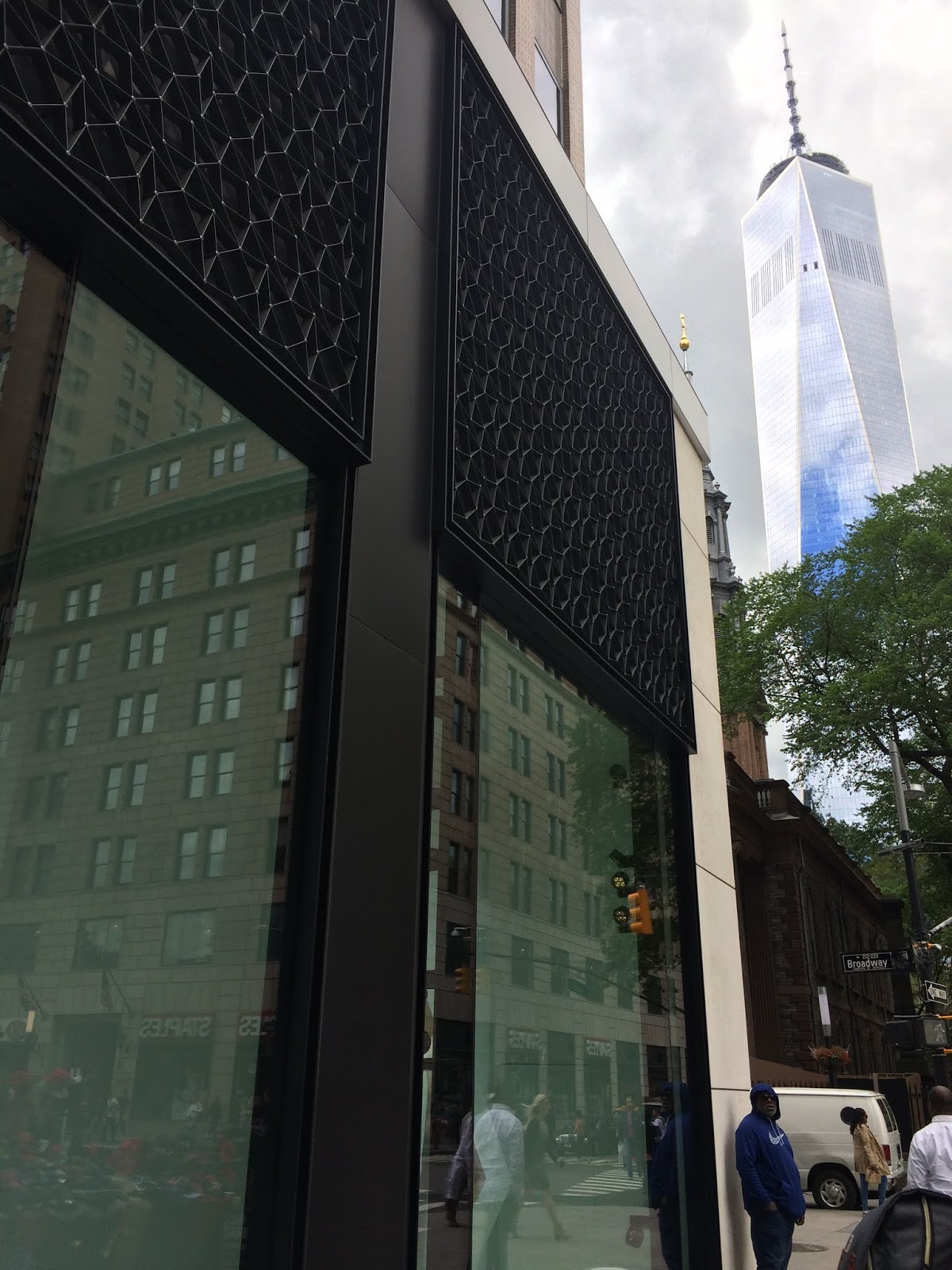
The next three stops have changed so radically since Poe’s time that it’s nigh impossible to even locate the addresses in question. 154 Greenwich St is now part of the World Trade Center area. 


 O’Hara’s Pub is fairly picturesque; Poe lived where the restaurant now stands, and there is something vaguely Poe-ish about the building’s red brick and wood paneling.


Ann St, on which Poe lived (4 Ann St) and worked (25 Ann St) isn’t much to look at. As far as I can tell, Zara’s now stands where his residence was.


Another of Poe’s residences, 195 E Broadway, is now part of the Manny Cantor Center. Across from it is a beautiful New York Public Library building.


Now to Greenwich Village. It seems only natural that Poe would have lived here, in the charming place so many writers and artists have called home.

At Waverly Place and Christopher St, in the middle of a street triangle, is the Northern Dispensary, founded in 1827. It was here during Poe’s time and he (supposedly) once visited to buy medicine for a cold. The old brick building is still intact and conjures up Poe’s Manhattan better than any of the other buildings seen on this tour so far.


Just steps away is Waverly Place and 6th Avenue, where Poe resided at one time.


From there, it’s a short walk to 85 W 3rd St, where Poe lived in 1845. Here he wrote “The Facts in the Case of M Valdemar” and revised and published “The Raven.” The original building is no longer here, but NYU (pressured by preservationists) has made some attempt to replicate the facade of Poe’s building.
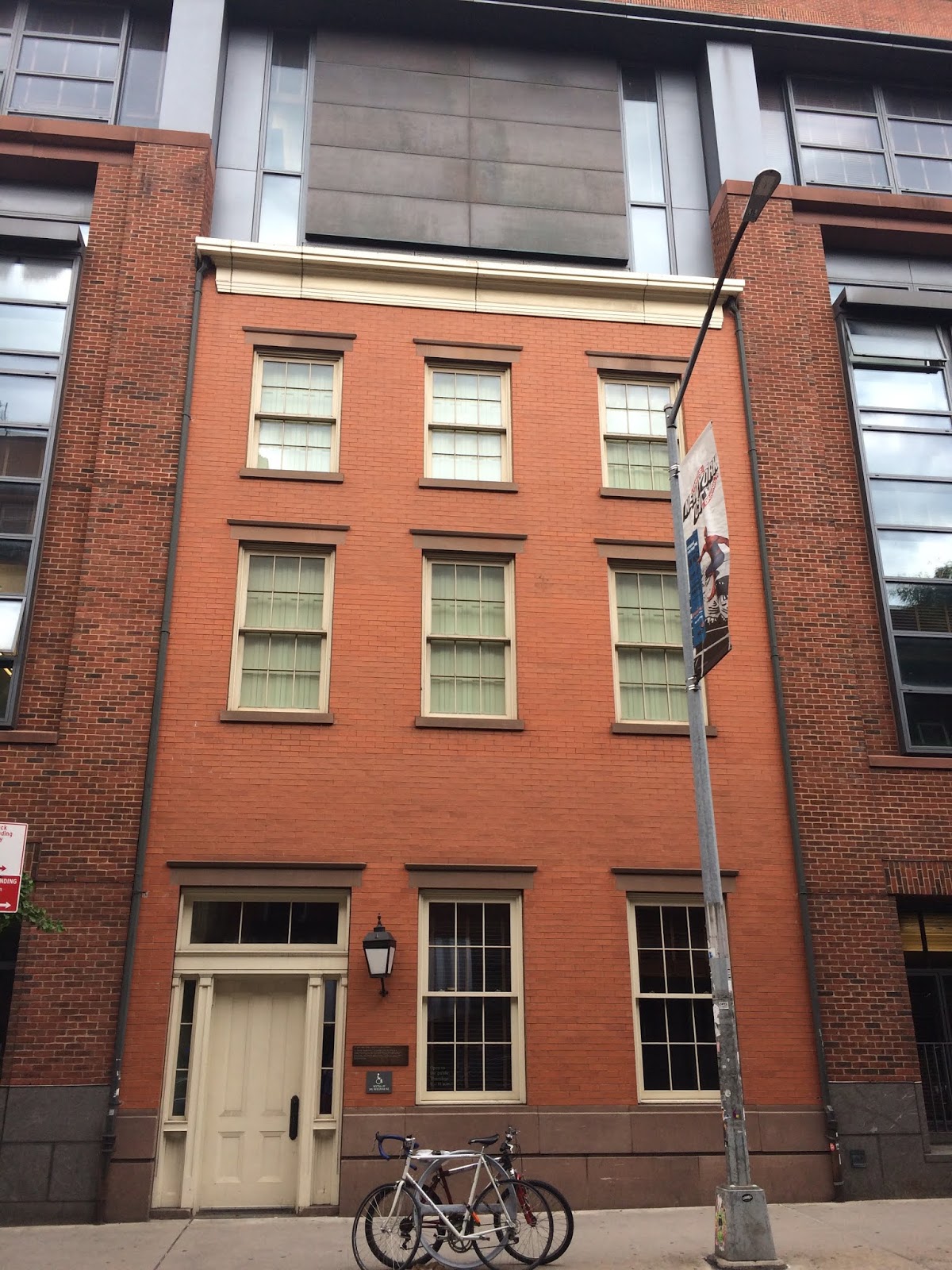


It’s definitely the best preserved of Poe’s residences I’ve seen today, but then again that’s not saying much. Still, it’s charming. The building is open to the public from 9 to 11 AM on Thursdays, but honestly I doubt it’s worth going into, as it’s now simply NYU offices. The banister of the original staircase has been preserved.


The intriguing 113 1/2 Carmine St (reputedly another of Poe’s residences) no longer exists, but a walk down Carmine St is nice regardless.

Now to the last stop on this tour of non-existent locations: 
E 47th St and 2nd Ave

What I’ll find there is anyone’s guess. Probably nothing.


At E 47th St and 2nd Ave is a rather nice park, as urban parks go. It features a long mall framed with benches and tall, slender trees—their wispy branches reveling in the wind.


There’s also a black structure like a skeletal Greek temple, and a series of fountains that look vaguely Gothic. 


As I watch, a pigeon lands on the edge of the fountain’s dish and I just manage to snap one photo before it flies away, beating its wings and rising upward.


It’s not a raven, but I’ll take it.

.........................................................................................................................

In case anyone is wondering, I have only two Poe cities left to visit before my goal is complete: Richmond, Virginia; and Poe's house and grave in Baltimore, Maryland.

Happy October!


Until tomorrow.

Wednesday, September 21, 2016

Into the Worlds Part II: Concord Literary

"I went to the woods because I wished to live deliberately, to front only the essential facts of life, and see if I could not learn what it had to teach, and not, when I came to die, discover that I had not lived." - Henry David Thoreau, Walden


 Ever read it? If you haven't, you should.

When I told my grandma that I wanted to visit Walden Pond on my family's visit to the east coast this summer, she said it wasn't worth my time; she'd been there some years ago, and the famous "pond" which serves as the center for one of the great American novels was little more than an enlarged puddle beside a picnic table in a pathetic little state park somewhere in Massachusetts.

This puzzled me, because I had seen photos of Walden Pond and the surrounding area (designated as a national historic site and state reservation) online, and it looked like a pretty big deal. Among other things, the Park professed to include a vast public recreation area with hiking paths and swimming facilities, as well as a recreation of Thoreau's cabin, a statue of the author, and a marker at the site of the original cabin where he wrote his book Walden - detailing how he lived for two years in a simplistic one-room cabin in the woods. Judging from these photos, the pond itself was a dazzlingly blue vastness ringed by tall green trees.

Whatever the actual state of Walden Pond, I was determined to see it one way or another, and with this aim, among others, I traveled to the town of Concord in August.
Orchard House, Concord, MA: Home of the Alcotts from 1858 - 1877

Concord, MA is a lovely little historic town with a quaint main street, dozens of historic homes, a high-quality museum, picturesque cemeteries, and the famous Old North Bridge - now Minute Man National Historical Park. The town served as the scene of some of the first events in the American Revolution, as well as the home of Louisa May Alcott, Ralph Waldo Emerson, Nathaniel Hawthorne, and Henry David Thoreau.

As you may know, Louisa May Alcott wrote the beloved classic Little Women. If you've read the book or seen the movie, it's well worth making the literary pilgrimage to Orchard House, the Alcott's Concord home. If you haven't, it's still worth it. Some literary or historic sites disappoint - as in the Old Corner Bookstore in Boston that is now a Chipotle Restaurant, or the site of the famous Salem Witch Trials (I'll get to that later) - but Orchard House is very nearly a sacred experience. Nothing beats walking into a room and realizing that it holds the actual piano played by Louisa's short-lived sister Beth, or the small round writing desk under the window in her bedroom where Louisa wrote the entirety of Little Women. It doesn't get any better than seeing the drawings that May Alcott (Amy in Little Women) drew all over her walls, or looking at the stairs in the living room which the Alcott sisters used as a backstage area for their plays. The house is instantly recognizable as the familiar setting of Little Women, and it's worth the trip.

The only regret I have about my trip to Concord is that we didn't schedule enough time in the town to see everything there. We saw the home of Ralph Waldo Emerson - the foundational American poet, author, philosopher, and lecturer - but only from the outside; and we drove past The Old Manse, where Nathaniel Hawthorne lived briefly. The Concord Museum is worth visiting if you're interested in seeing the actual lantern hung by Paul Revere's friend in the Old North Church in Boston, a recreation of Emerson's study, Thoreau's writing desk, and similar historic and literary treasures. They also had a beautiful exhibit of N. C. Wyeth's illustrations for the book Men of Concord, which includes selections from Walden.

The Old North Bridge, site of the "shot heard round the world" is now a national park, with hiking and boating options and access to the Minute Man Monument.
Minute Man Historical Monument

Sleepy Hollow Cemetery stands amid Concord's other historic sites. And no, it is not the Sleepy Hollow of Washington Irving's short story featuring Ichabod Crane and the Headless Horseman. I don't know where that cemetery is or if it even exists, but it would be cool to visit if it did.

The Sleepy Hollow of Concord holds the graves of the families Alcott, Hawthorne, Thoreau, and Emerson. Apparently all of these famous authors had the decency to be buried very near each other, making a visit as convenient as possible for tourists. Thanks, guys. Good planning.

Emerson's grave is a giant slab of marble, befitting the thinker who laid the foundation of American intellectualism, but all the others' graves are surprisingly humble. Most are short and rather squat, often bearing only the first name or initials of the deceased.
The Thoreau family plot in Sleepy Hollow Cemetery; Henry's grave is on the far left

From there - at last - to Walden.

It's a short drive from Sleepy Hollow Cemetery to Walden Pond State Reservation. Leaving the parking lot (which is happily full), you're suddenly confronted with a striding statue of Henry Thoreau and a recreation of his one-room cabin. Stepping out of the car and seeing the statue and cabin was like stepping into a dream - or a place in a story that I'd never really expected to see in person.

The recreated cabin is not "authentic" in the sense that it stands in the original location of Thoreau's cabin or contains any of the actual artifacts, siding, or flooring that stood in the cabin built by Thoreau in 1845. But it is authentically recreated to resemble Thoreau's cabin as closely as possible, with the inclusion of the woodshed on one side. 
I pose with the author

From there, die-hard fans can take a semi-short walk through Walden Woods to view the original site of Thoreau's cabin, woodshed, and chimney, marked with a small, humble monument. The walk seemed longer because I visited the east coast during record-breaking heat, but I think it was under a mile. 

And the woods are beautiful.

Yes, Walden Pond is a shimmering blue lake, ringed with sky-stretching trees - a very far cry from the bench-side puddle described by my grandma (incidentally, if you're wondering, we finally deduced that she visited the wrong Walden Pond on her visit to the east coast). Surveying Walden Pond from different angles, you can see many of the features that Thoreau so painstakingly describes in his book, such as the bluish-green color of the water's edges.

And, the ants.

If you've read Walden, you may remember that Thoreau spends a good amount of text describing the ants that live in Walden Woods. It's one of the things that causes some people to write the book off as tedious and boring, but to Thoreau, a battle between different ant breeds was honestly the most exciting thing imaginable. As I traced the path that Thoreau and Emerson often took together through the woods, I looked down to see an ant scurry across the dirt in front of my feet. Anywhere else, it would have been a commonplace occurrence, but in Walden Woods - it was somehow extremely exciting.

As I trekked towards the site of Thoreau's original cabin, large gusts of wind shook the trees around me. I'm not so self-absorbed to believe that I'm the only true lover of Thoreau ever to have visited Walden, or that all of nature conspired on my behalf to make my visit to Walden particularly memorable, but sometimes we're granted little mercies, and this was one of mine.

And there, at the site of the cabin, beside a pile of rocks casually heaped like a monument, stands a wooden placard with Thoreau's famous quote painted on in white:
"I went to the woods because I wished to live deliberately, to front only the essential facts of life, and see if I could not learn what it had to teach, and not, when I came to die, discover that I had not lived."
Light breaks through Walden Woods

From Walden, we drove to Salem, MA, site of the historic Salem Witch Trials in 1692 and 93.

I'm going to give any prospective tourists to Massachusetts some advice that they probably won't heed: don't visit Salem.

I know you won't heed it because if someone had told me that prior to my trip, I would have completely disregarded them and gone to Salem anyway. But it would have been more worthwhile to spend the whole day in Concord and not try to cram in Salem.

I know what you're thinking: "but the Salem Witch Trials!" Yeah, I know. I've read my share of books about the Witch Trials, learned about them in history class, found them intriguing, thought it would be beyond cool to visit the site where they actually took place. But the thing is, that site doesn't really exist anymore. Salem, MA today is not really a cool town. It has some lovely historic houses, but most of them date from the 1800s, and only one was actually standing as is during the Salem Witch Trials. It's called "The Witch House," because it belonged to one of the judges implicit in the Witch Trials, and it did feel kind of creepy, but that could have just been because it was dark when we went to the house. Also, it was closed, so I can't tell you whether or not it was cool inside, but I'm guessing it wasn't worth visiting Salem just to see the inside of that house.

Salem also houses Nathaniel Hawthorne's "House of the Seven Gables," which seemed mildly cool, but once again, it was closed when we got there, so I can't tell you whether or not going to the House of the Seven Gables is worth a whole trip to Salem. I mean, if The House of the Seven Gables is absolutely your favorite book, then maybe it's worth a trip. I can tell you that it did definitely have a lot of gables.

Also in Salem is the custom-house Hawthorne worked at for a while, and the original East India Company Trading Store, which is also fairly cool, but not worth an entire trip. I visited the Salem Witch Museum, which was sort of spooky but not really in a cool way, and mainly focused on presenting a highly political agenda.

Apparently there is a museum in Salem where actors and actresses reenact the Witch Trials, and I do think that would have been cool to see, but it was closed when we got there. Also closed was the Pioneer Village, which I have been told is really neat. However, the curator at the House of the Seven Gables told us that the Pioneer Village is open very sporadically. So I guess my advice to those of you who are dead set on seeing Salem is: check out the hours of the Pioneer Village ahead of time, and get there early in the day so all the non-lame attractions are still open.

Basically, the best thing about Salem was this awesome nerdy store that was selling Harry Potter and Dr. Who merchandise. But everything was too expensive for me, so yeah, even that was kind of a bummer.

By complete accident, we stumbled upon the memorial to the Salem Witch Trials, which is legitimately cool but extremely hard to find and not at all well-marked. It stands on the other side of a cemetery wall, and it was dark when we found it, so atmosphere = good. The names, death dates, and causes of death of the victims of the trials are inscribed on large stones set into a wall. It's a well-done memorial, but again, very difficult to find. I expected more.

I had a slightly creepy feeling in Salem; I don't know if it was just because I was there in the dark, if it was because I went through the Salem Witch Museum first, or if it was a legitimate feeling, but it was a little discomfiting, and I like to think (because it's more interesting than the other options) that the town has a bad aura because of all the innocent people who were executed there out of fear, ignorance, and spite. I suppose there's no way to know for sure.
Literally the coolest thing in Salem is this statue of some random Puritan dude

Go to Concord; skip Salem. And, whatever you do, live deliberately.


Until tomorrow.

Wednesday, August 31, 2016

Into the Worlds Part I: Searching for Olympus in Manhattan

So I know you're all dying to hear about my trip to the East Coast last month.

Oh, you didn't know? Well, I think it's appropriate for this blog, as it was very literary-heavy. But before we get started, announcements.

What the heck is this??????

J.K. Rowling Is About to Release 3 New Harry Potter Books

Don't get too excited: I'm not sure they're actually "Harry Potter" books. But, do get pretty excited, because they're about Hogwarts.

Now that we've got that out of the way, it's time for another Percy Jackson-related post! (Come on, it's been, like, what, three months since the last one?)


Into the Worlds Part I: Searching for Olympus in Manhattan

We (my family and I) spent the first part of our trip in Manhattan. One of the first things Anna did upon arriving was walk into the NY Yankees store and buy a baseball cap.

In the Percy Jackson universe, Manhattan is supposed to be the place where the old gods and goddesses of Ancient Greece take up their residence in the modern world. While I'm sorry to say I didn't actually see any live Greek gods or goddesses (I mean, I might have, I just didn't know it), I quickly came to the conclusion that if there's one place in the modern world that the old gods have come back to, it's definitely Manhattan. Not only is it the cultural hub of the modern world, there are allusions to the Greek gods all over the place. For a prime example, check out the statue on the Helmsley Building above (honestly, I have no idea what the Helmsley Building is, I just saw Hermes and took a picture). Looks like Hermes and probably Demeter, with her trademark wheat in tow.

Or take a look at this mural on the ceiling of the New York Public Library: 
It's Prometheus bringing fire to mortals (for which he was afterward punished by being chained to a rock and having his liver eaten out every day by a giant eagle, but you know, whatever). I thought this was such a cool mural to have in the New York Public Library! Prometheus' fire represents the spark of knowledge, the flame of creation, the bringing of light into the world. 

Flanking the library on either side were two fountains with statues of what look like Aphrodite and a Greek philosopher.


I'm pretty sure this is a front for Zeus's center of operations in upstate New York.


And yes, I did visit the Empire State Building.

So I could care less that the Empire State Building is an excellent example of whatever architectural style it is, and that it was the tallest building in the world when it was constructed, and a monument to modern society and all that - I just wanted to visit the gateway to Mount Olympus!

Unfortunately, we didn't actually find Olympus, but that proves nothing! As every demigod knows, you can't get into Mount Olympus if the gods don't want you to. We did, however, find an elevator and snap this picture of Anna[beth] in her Yankees cap:

Tune in next time for the story of my literary rambles around New England.

Until tomorrow.


Oh yeah, this happened too. The show closes its Broadway run on September 4, so I feel extremely lucky to have seen it.

This is pre-seeing-Les-Mis-on-Broadway.

And post....


#LongLivetheRevolution
#ButNotTheShow
#BecauseIt'sClosing
#Why