Showing posts with label Rick Riordan. Show all posts

Tuesday, June 5, 2018

Why I would probably sell my soul to Rick Riordan if he asked me to

Why do I love Rick Riordan so much?

Is a question I have never asked myself because, let's be real, what's the point? Also it's just sort of obvious. Who doesn't love Rick Riordan? (OK, you can leave.)

That being said, here are a few possible reasons behind my enthusiasm for the man and his books. Feel free to share yours in the comments, or tell us your favorite Rick Riordan book and/or quote.

Rick Riordan Camp Jupiter Camp Half-Blood
(Rick Riordan's only rival is himself)


Reason 1: His books just keep getting better


Once upon a time there was this MG series called Percy Jackson and the Olympians, and it was like nothing else that came before it. Percy Jackson was this king of sass who was also vulnerable and had adorable friends, and they got up to all these crazy adventures involving ancient Greek monsters and gods in modern times. It seamlessly blended ancient Greece and contemporary America, and it was chalked full of originality, wit, humor, and pretty non-stop action. My favorite novel in the series was The Titan's Curse, which I read in about 24 hours, I think.

When we finished that series, with Annabeth challenging Percy to a race down the hill (ah, bittersweet memory), it kind of felt like an era in our lives had ended. But I bet you all remember reading Rick Riordan's acknowledgements at the end of the book and snagging on the line where he thanks someone for helping him with his "first Camp Half-Blood series."

FIRST??? SO THERE WILL BE MORE??????

And there were more. And if we thought that first series was good (it was), the next books just kept getting better and better. Sure, some of us will always have a rose-colored view of that first series, and sure, some of the following books have been better than others. But then Riordan drops something like The House of Hades, or The Hidden Oracle, or The Dark Prophecy, and it's like, "dang, Riordan, I knew you could write, but - well, dang!"

Reason 2: He throws out fabulous one liners like nobody's business


"I confess I lost track of the specifics after he explained about the exploding chain-saw Frisbees."

"You hit the Lord of the Titans in the eye with a blue plastic hairbrush."

"With great power... comes great need to take a nap. Wake me up later."

Rick Riordan is the master of one liners. His off-the-wall brand of humor is one of the things that made those first Percy Jackson books so great, and now it's become his hallmark. What other book (except the ever-present Hitchhiker's Guide to the Galaxy) contains lines of such memorable, well-aimed goofiness?

Reason 3: He is the master of the subtle art of haiku


How many of us could come up with an original, clever haiku for each chapter of a book? And then do the same thing for two more books?

Reason 4: He is the master of the subtle art of killer book dedications


You all know what I'm talking about.

Reason 5: He pretends his fans have a love/hate relationship with him but everyone knows we'd probably jump off a cliff into Hades after him


Riordan knows he has us wrapped around his finger, but he plays it cool, pretending we hate him because he's such a troll (we pretend that too, but let's be real, his trolling only makes us love him more). And he keeps giving us more of what we want, and it's pretty consistently awesome. Like how much stuff has this guy churned out, now? Not just novels, but all those things like The Demigod Files and Percy Jackson's Greek Myths. To say nothing of his other series that take place outside of Camp Half-Blood.

Reason 6: He's giving us a whole series about Apollo


'Nuf said. Now you know
Rick Riordan is our man
We love him a lot


Happy birthday, Rick Riordan! Here's to many more demigod adventures.


Until tomorrow.

Wednesday, August 31, 2016

Into the Worlds Part I: Searching for Olympus in Manhattan

So I know you're all dying to hear about my trip to the East Coast last month.

Oh, you didn't know? Well, I think it's appropriate for this blog, as it was very literary-heavy. But before we get started, announcements.

What the heck is this??????

J.K. Rowling Is About to Release 3 New Harry Potter Books

Don't get too excited: I'm not sure they're actually "Harry Potter" books. But, do get pretty excited, because they're about Hogwarts.

Now that we've got that out of the way, it's time for another Percy Jackson-related post! (Come on, it's been, like, what, three months since the last one?)


Into the Worlds Part I: Searching for Olympus in Manhattan

We (my family and I) spent the first part of our trip in Manhattan. One of the first things Anna did upon arriving was walk into the NY Yankees store and buy a baseball cap.

In the Percy Jackson universe, Manhattan is supposed to be the place where the old gods and goddesses of Ancient Greece take up their residence in the modern world. While I'm sorry to say I didn't actually see any live Greek gods or goddesses (I mean, I might have, I just didn't know it), I quickly came to the conclusion that if there's one place in the modern world that the old gods have come back to, it's definitely Manhattan. Not only is it the cultural hub of the modern world, there are allusions to the Greek gods all over the place. For a prime example, check out the statue on the Helmsley Building above (honestly, I have no idea what the Helmsley Building is, I just saw Hermes and took a picture). Looks like Hermes and probably Demeter, with her trademark wheat in tow.

Or take a look at this mural on the ceiling of the New York Public Library: 
It's Prometheus bringing fire to mortals (for which he was afterward punished by being chained to a rock and having his liver eaten out every day by a giant eagle, but you know, whatever). I thought this was such a cool mural to have in the New York Public Library! Prometheus' fire represents the spark of knowledge, the flame of creation, the bringing of light into the world. 

Flanking the library on either side were two fountains with statues of what look like Aphrodite and a Greek philosopher.


I'm pretty sure this is a front for Zeus's center of operations in upstate New York.


And yes, I did visit the Empire State Building.

So I could care less that the Empire State Building is an excellent example of whatever architectural style it is, and that it was the tallest building in the world when it was constructed, and a monument to modern society and all that - I just wanted to visit the gateway to Mount Olympus!

Unfortunately, we didn't actually find Olympus, but that proves nothing! As every demigod knows, you can't get into Mount Olympus if the gods don't want you to. We did, however, find an elevator and snap this picture of Anna[beth] in her Yankees cap:

Tune in next time for the story of my literary rambles around New England.

Until tomorrow.


Oh yeah, this happened too. The show closes its Broadway run on September 4, so I feel extremely lucky to have seen it.

This is pre-seeing-Les-Mis-on-Broadway.

And post....


#LongLivetheRevolution
#ButNotTheShow
#BecauseIt'sClosing
#Why

Thursday, June 2, 2016

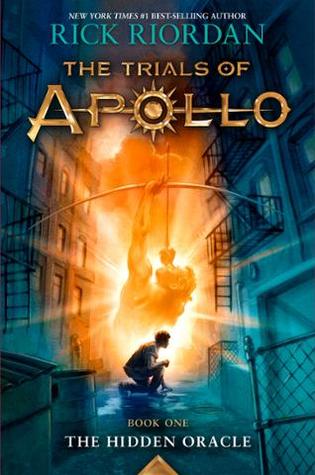
Rick Riordan's The Hidden Oracle

What happens when Rick Riordan writes a book narrated by Apollo?

Pure awesomeness.

And a lot of haiku.


Title: The Hidden Oracle (The Trials of Apollo #1)
Author: Rick Riordan
Publisher: Disney Hyperion
Publication Date: 3 May 2016
Number of Pages: 361
Purchase: AmazonBarnes and NobleAbeBooksPowell's Booksebay


What Goodreads has to say:


How do you punish an immortal?

By making him human.

After angering his father Zeus, the god Apollo is cast down from Olympus. Weak and disorientated, he lands in New York City as a regular teenage boy. Now, without his godly powers, the four-thousand-year-old deity must learn to survive in the modern world until he can somehow find a way to regain Zeus's favour.

But Apollo has many enemies - gods, monsters and mortals who would love to see the former Olympian permanently destroyed. Apollo needs help, and he can think of only one place to go . . . an enclave of modern demigods known as Camp Half-Blood.

What I have to say:


Some of you may remember my review of The House of Hades that I posted on this blog a couple years back; which I ended with the request that Apollo return to the series. Like most Percy Jackson fans, I first met Apollo in The Titan's Curse (Book 3 of the Percy Jackson and the Olympians series), and almost immediately he became my favorite character in the Percy Jackson universe. His sense of humor, strong personality, and huge ego endeared him to me as a character, and I loved that he disguised himself as a bum to help Percy and Co. succeed on their quest, because even though the Gods aren't supposed to interfere with demigod quests, Apollo wasn't going to let some Titan kidnap his sister and get away with it.

Plus, I've always liked Apollo as an Olympian, even outside of the Percy Jackson series. What's not to love about a God who single-handedly presides over poetry, music, medicine, truth, and the sun? And I always knew that if I were a demigod at Camp Half-Blood, I'd be in the Apollo cabin.

But I don't recall Apollo playing a prominent part in the rest of the Percy Jackson and the Olympians series (which is probably as it should be, I mean come on, if he featured in any of the other books he'd just steal the show and we'd have to rename it the Apollo and the Olympians series); and while he did appear briefly in the more recent Heroes of Olympus series, I always hoped we'd get to see Apollo again at some point. 

My request has been honored, and I couldn't be more pleased.

The Hidden Oracle is a masterful piece of artistry that would make Apollo himself proud.

I've heard some people express disgruntlement with the fact that Rick Riordan seems to be going hog-wild writing books all over the place. I don't understand why that would make anyone feel disgruntled. If the quality of an author's books suffer because he's writing too much or is overconfident in his abilities, that's a justifiable cause for disgruntlement. But I don't find that to be the case with Rick Riordan's books. 

Yes, there were moments in the Heroes of Olympus series when I had this impression, but in The Hidden Oracle, I find Riordan to be more in command of his powers as a storyteller than ever before. 

This book may just be the best Rick Riordan book yet (although that first Percy Jackson book was crazy good, and Titan's Curse was amazing, read it in 24 hours I think, but I digress). 

It feels a little like Riordan has matured as a storyteller, but maybe part of that's just the different character: Apollo is an immortal who has lived for - centuries? millennia? He's seen civilizations rise and fall, he's been in and out of love more times than I think even he can count, and he's dealt with tragic loss. Now he's a teenager with acne. And his brain's a little fuzzy, but he still has more knowledge and experience than Riordan's average protagonists.

And I found him more powerful emotionally than the average Camp Half-Blood teenager. His character seems somehow deeper and more genuine than Riordan's usual protagonists. And don't get me wrong - I love the whole demigod team - it's just that I find Apollo to be a deeper character, if only because he's lived about a billion times longer and is, after all, a god.

Can I talk about the haiku now?

When I realized there was an Apollo-authored haiku at the beginning of every chapter in this book, I flipped out (legit - my mom asked what was going on and my sister told her not to worry, I was just fangirling). But oh, the haiku. Seriously, I don't think you're picking up on how awesome this is. Get excited, people.

Now that I've stopped flipping out (hahaha if only) maybe I can finally get down to - you know - talking about the actual book. 

(The dedication killed me).

When the story opens, Apollo is in a pretty big mess. 

Literally: the once glorious Olympian God of poetry, truth, and light wakes up in a dumpster in some back alley in New York. 

The context: due to his father Zeus's perception that the recent war which almost destroyed the Gods was mainly Apollo's fault (come on, he was barely involved and completely innocent), the King of the Gods decides to punish his son by turning him mortal until he has proven his worth anew. Luckily, Apollo befriends some demigods, among them a street urchin named Meg, the famous Percy Jackson, and some children of Apollo (try rooming with your own kids who are suddenly older than you and better than you at all the hobbies you invented); with the help of his demigod friends, Apollo seeks shelter in Camp Half-Blood and tries to begin the process of making things right again. There's a prophecy (there always is, right?), some mysterious backstory, and some run-ins with mythological beings. Ultimately Apollo must find and save the ancient Oracle of Dodona, the most powerful and sacred of all the oracles belonging to Apollo.

From here on out there might be some spoilers, but I won't give away anything big, just stuff like who dies, who comes back to life, and who kills the main character. Kidding, none of that stuff actually happens in this book.

Meg McCaffrey, the street urchin demigod who serves as Apollo's counterpart throughout most of the novel, is a child of Demeter, and correct me if I'm wrong, but I don't think we've seen a child of Demeter before in the Percy Jackson universe. 

At first I thought having a child of Demeter - goddess of nature and harvest - as the secondarily main character was kind of boring, but then I got to like it, and now I think it was a really cool move on Riordan's part. Of course it's glamorous to be the son or daughter of Zeus, and it's cool to be able to control water because your father is Poseidon, or to be blessed with great wisdom because your mother is Athena, but having a deep affinity with nature because your mother is Demeter definitely has merit. Aren't the forces of nature the most powerful forces of all?

And the antagonist - if you want to be surprised, skip this paragraph - but he's Nero. As in the insane Roman Emperor who reportedly "fiddled while Rome burned" (though as he reminds Apollo, that's crazy talk; they didn't even have fiddles in ancient Rome). And what better antagonist than Nero, the insane Emperor who built a colossal statue of himself in the nude, could there be to Apollo's protagonist? The two characters are both reflections and polar opposites of each other. Apollo represents light, truth, and beauty; while Nero personifies disorder, corruption, and twistedness. And yet, at the same time, even Apollo has to admit that the two share an exaggerated sense of ego and have willingly let others die to serve their own "higher" interests. This is just one of the signs that Riordan has come into his own as a storyteller.

Another is the way in which Apollo's backstory slowly unravels: the author teases us with hints of things that have happened in the protagonist's past, pulling us along by giving out just a little at a time until, finally, we know the whole backstory and it so perfectly illuminates the present.

There are certain things you can do when the main character of your story is Apollo that you can not do with any other character. One of them is that you can throw out historical and pop culture references like there's no tomorrow - because Apollo has inspired all great artists, and some inventors as well. Also, he's been around forever. As an English major and a history nerd, I ate it up. 

Another thing you can do when your protagonist is the god of music and poetry is showcase the power of music in its purest and divinest form. The way Riordan writes about music as performed by Apollo is beautiful. It stands out from the rest of the novel by simple virtue of that beauty and power. One of my favorite scenes occurs when Apollo attends Camp Half-Blood music lessons only to wind up making everyone in the class cry because he's the god of music and he'll make you sob just by tuning his guitar.

I also loved seeing Apollo as a father interacting with his demigod children. Some of the other Olympian parents obviously care about their children, but they always seem rather distant, and sometimes they're just plain negligent. Not saying Apollo has never been a negligent father, but he seems more emotionally connected to his children than the other Olympians do. It's one of the things that makes him more real as a character.

Towards the end there was a plot twist that I never saw coming. Masterfully done, Rick Riordan.

And kudos to Rick Riordan's proofreaders!!!! If you remember the aforementioned review of The House of Hades, you'll recall that I expressed some frustration with the book's editors who failed to catch about six dozen typos throughout the manuscript. I only counted one or two in The Hidden Oracle. Good job, guys!

And that brings us to the end of the story, which was - it was good, people. It was good.

If I had any criticisms of the book, this is what they would be:

There's still that slightly frustrating tendency of Riordan's to make light of a desperate and/or emotionally tense moment in a book at the expense of destroying all the tension with one off-the-wall comment. I think it was less prevalent in this book than in the Heroes of Olympus series, but there were still a couple of times when I was really invested in the situation, and then the narrator said something kind of silly and lost my undivided attention. Part of the appeal of the Percy Jackson series was the zaniness, off-the-wall observations, and sarcasm of the protagonist. It worked brilliantly in that series, but I'm not sure Riordan has to put it on twenty-four seven in all of his other books, and I'm also not sure he knows that he doesn't have to. 

This brings me to an observation about the style of the novel. It's almost like the author is trying to straddle two different age groups. One is the group that understands the references to Woodstock, Heart of Darkness, and Irving Berlin and knows the expression "fiddled while Rome burned"; the other is the group that was the intended audience of the first Percy Jackson books. I am NOT trying to dis the original Percy Jackson books or be condescending towards younger readers and/or people who enjoyed those first books (I'm one of them, remember). I'm just trying to convey the only thing that I felt was a little off about this book. It's like Riordan is trying to cater to two separate crowds. Maybe it's because the original readers of his books are older now. I guess the fact that we're still reading him means he must be doing something right.

About halfway through reading this book, I realized how awesome it would have been if I'd haiku-tweeted my way through the novel - meaning I would post my reactions to certain parts of the novel in haiku form at regular intervals. But by the time I had the idea, it was kind of too late. Learn from my mistake.

There's not really anything left to say except to once more point out the pure awesomeness of The Hidden Oracle and express how much I am looking forward to the second book in The Trials of Apollo series. So have a look at some of my favorite lines from the book that will definitely not give away any spoilers except just one about that person who dies on page 302 (kidding again):

I took a deep breath. Then I did my usual motivational speech in the mirror: "You are gorgeous and people love you!" 

"If anybody gives you trouble, Kayla will shoot them. Then I'll curse them so bad they'll be speaking in rhyming couplets for weeks." My eyes watered... I couldn't recall the last time someone had cared enough to curse my enemies with rhyming couplets.

I confess I lost track of the specifics after he explained about the exploding chain-saw Frisbees. "And they'll be like, ZOOM!" He bounced up and down with excitement. "And then BUZZ! And POW!... You have to be really quick or you'll die, and it's awesome!" 

"You guys go," Will told me. "The chariot is only designed for three, and after that shadow-travel, Nico is going to pass out any second." "No, I'm not," Nico complained, then passed out.

A sonnet I could have handled. A quatrain would have been cause for celebration. But only the deadliest prophecies are couched in the form of a limerick.


For more of the same
Read The Hidden Oracle
Plus it has haiku 


Until tomorrow.

Thursday, May 15, 2014

The House of Hades by Rick Riordan

http://bookerie.files.wordpress.com/2013/10/rick-riordan-house-of-hades.gif 
Title: The House of Hades
Author: Rick Riordan
Series: The Heroes of Olympus
Date of Publication: October 8th 2013
Publisher: Hyperion Books

What Goodreads has to say:

At the conclusion of The Mark of Athena, Annabeth and Percy tumble into a pit leading straight to the Underworld. The other five demigods have to put aside their grief and follow Percy’s instructions to find the mortal side of the Doors of Death. If they can fight their way through the Gaea’s forces, and Percy and Annabeth can survive the House of Hades, then the Seven will be able to seal the Doors both sides and prevent the giants from raising Gaea. But, Leo wonders, if the Doors are sealed, how will Percy and Annabeth be able to escape?

They have no choice. If the demigods don’t succeed, Gaea’s armies will never die. They have no time. In about a month, the Romans will march on Camp Half-Blood. The stakes are higher than ever in this adventure that dives into the depths of Tartarus.

What I have to say:

Last night I finished The House of Hades, Book 4 in The Heroes of Olympus series by Rick Riordan. And yes, I know that every Percy Jackson fan on the planet has probably already read The House of Hades, but I've heard surprisingly little about it, so I'm going to review it even though I'm a little late. Also, IT WAS AWESOME!

I think this is possibly Rick Riordan's best book to date. But then I remember how much I liked The Lightning Thief and The Titan's Curse, so I'll just say that The House of Hades was definitely among the best of Rick Riordan's books so far. Here are my reasons: This book was surprisingly complex and heavy for a teen book. There were so many different stories, but I was pretty invested in all of them, unlike some of the previous books in the series. And the narrative dealt with some fairly heavy concepts. There were also a couple of threads or themes that ran throughout the book and helped to unify all the different plots and characters. And there were a few of those really great moments in the story when something you never saw coming happens suddenly and unleashes its full force upon you. These are the main reasons I felt this book worked so well. Let's go into specifics.

I loved The Lost Hero, but was pretty disappointed in Son of Neptune. While I like Percy (who doesn't?) Hazel and Frank were just lame, and so I had trouble investing in the story. I also felt that the writing was not as good as Riordan's other books, and Ella the harpy was super annoying (sorry if anyone likes her, but not really). The Mark of Athena was better, but I feel that with The House of Hades, Riordan finally delivered. It was fast-paced, multi-layered, and surprising, with fairly endearing characters and the fate of the world in the balance (hey, look - a pun). The characters really worked - at last. I like Frank now; I can stand Hazel; and I'm thinking Coach Hedge is pretty cool. I already liked all the other protagonists, but I probably like them more now than I did before, especially Leo. I think seeing all of the characters really get tested helped with this. It was cool how Hazel learned to manipulate the Mist, how Piper really stepped up when all of her companions were suddenly rendered helpless, how Jason had to make a hard decision, and also had to protect a secret for someone else, how Frank had to lead - something he was never good at, and of course, how Percy and Annabeth got through Tartarus. Percy kind of had to overcome his fatal flaw, and Annabeth had to cope in situations where her usual wisdom and cleverness wouldn't be enough. So, I really liked all the different story lines and felt that they worked well together throughout the book.

This book dealt with some heavy topics, such as the persistence of evil and suffering: it seems like these things are always there (because they are) and that they will triumph over virtue and happiness in the end. Percy despairs in Tartarus when he realizes that the monsters he keeps fighting will always regenerate and come back, wondering if it's pointless to keep fighting. Percy and Annabeth also encounter some pretty dark and depressing things in the deepest region of the Underworld, and are often filled with sorrow and despair as they make their way to The Doors of Death. I found that the narrative's wrestlings with these topics made the whole story deeper and better. I think this is because in these moments the story cut to the heart of the whole struggle of humanity, and I know that sounds cosmic, but isn't the struggle of light against dark and the pursuit of happiness in the face of suffering the ultimate story underlying everything ever written? At least it seems to be at the heart of most stories.

Another thing I really liked about this book was the way that it brought everyone's different stories together under a unifying thread. The main thread that I picked up on was choice. The very first chapters of the book have Hazel standing at a crossroads seeing the different paths she could take. At the end of this encounter, Hazel tells Hecate, "I'm not choosing one of your paths. I'm making my own" (29). In retrospect, this encounter sets up the whole book. Almost if not all of the characters have to make their own choice at some point in the story, abandoning the paths that others have already laid down for them. Hazel has to choose which way to go in order to reach The Doors of Death, and she has to choose to successfully manipulate the Mist. Jason has to choose between Camp Jupiter and Camp Half-Blood. But I think the most prominent examples occur towards the end of the story, returning to Hazel's opening dilemma and echoing her words to Hecate. So....


WARNING: SPOILER ALERT!


Bob/Iapetus chooses which identity will define him. He tells Tartarus, "I am Bob...I choose to be more than Iapetus...You do not control me" (518). Damasen chooses to throw off his punishment, telling Annabeth, "I chose myself a new fate" (524). It was very powerful for me that he came in riding on the Drakon - the instrument of his servitude. He took the thing that was being used to control his destiny and turned it to his own use. He made his own choice. Finally, when Percy and Annabeth ride up through the Doors of Death, they choose to succeed: "'We can do this,'" Percy said. 'We have to.' 'Yeah,' Annabeth said. 'Yeah, we do'" (531). I found it very powerful that all of the characters chose to succeed - and then did. It was as if they realized that all that was needed to succeed was for them to decide to succeed. No matter what anybody threw them, they made their own choices. They were "the master[s] of [their] fate:" they were "the captain[s] of [their] soul."

And then, of course, there were those awesome moments when Rick Riordan threw me a curve-ball. There will probably be more spoilers throughout the rest of the review, because some of these moments were: finding out that Nico was gay! That took me surprise but then made perfect sense. The way that scene was done was pretty masterful, with the barrage of images all leading up to the final revelation; I felt like a wave had crashed over me. Well done.

The second of these moments was when Leo crash-landed on... guess whose island??? Calypso!! Ding! Ding! Ding! OK, so you can probably tell I was pretty excited. I always liked Calypso; she was so sweet and her story was so tragic, but she never got a happy ending and we never saw her again after Percy left her island. So when Leo crashed onto a dining table on the beach of a very isolated island - I freaked out. 

Damasen riding in on the drakon was pretty powerful, but I already covered that.

Also, I was pretty surprised by the appearance of Bob. I read The Demigod Files several years ago, and noticed that Rick Riordan never refers to the stories in that collection in the actual Percy Jackson novels, in fact, he acts as if they never happened, which is absolutely fine, but which caused me to be very surprised when he brought in a character from one of those stories. With Bob and with Calypso, Riordan drew in things from some of his older writings, and I found that very effective and exciting.

I also liked it when Hecate suddenly showed up at Hazel's side in the final confrontation. That was cool.

I have only two criticisms of The House of Hades. The first is Riordan's tendency to interrupt an extremely tense moment with a funny, off-the-wall line. Not that I don't love these lines, because I do; one of the best things about Riordan's books are these off-the-wall lines from teenage characters. But when you've been building up the tension for several chapters, and all the characters are facing their darkest moments so far, and Percy and Annabeth are face to face with Tartarus, and Frank is rallying an army of the dead, and Hazel and Leo are running through the labyrinth - a line telling me that Frank was hoping for fireworks just ruins it. It's as if the book suddenly spit me back out and reminded me that I'm just reading a story. So while I appreciate the humor, I think sometimes Riordan uses it in the wrong places.

Here's the second criticism: I've been informed that published authors have an editor who reads through their manuscript before publication and fixes all the grammatical and spelling errors. I don't think Rick Riordan has one of those people. There are a lot of typos in the book, sometimes three or four in a single chapter. There were several times when a word was omitted, or the wrong word was used, or a word was repeated. And once again, this takes me out of the story and reminds me that I'm just a person reading a book. I can understand and forgive an author missing a few typos in his manuscript; we're all human, after all. But I assume that there are several good editors working for a number one bestselling author over at Disney Hyperion press, so what happened? 

Anyway, all in all it was a great book. I really enjoyed it, and I'm looking forward to The Blood of Olympus on October 7th, the cover for which has already been released - go look it up. In the meantime, can I make a request of the author? Could we see Apollo again sometime? He was my favorite character, and as his name is the same in both Greece and Rome, I'm thinking he doesn't have to deal with the split personality thing that's incapacitating all the other Olympian Gods. 

Where is Apollo?
Haven't seen him since Titan.
He is so awesome.