Wednesday, July 12, 2017

A Six Year Old, An Assassin and Dragons!!


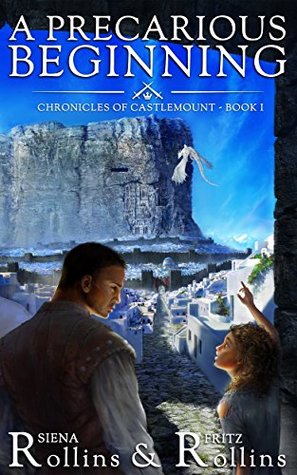
A Precarious Beginning
34870162

Title: A Precarious Beginning
Series: Chronicles of Castlemount
Authors: Siena and Fritz Rollins
Date Published: April 14, 2017
Publisher: Harpalin Press

Summary: “There are only two powers in the universe that determine what a person will become in life — luck and willpower.” 

Orphaned at a young age and forced to become a pickpocket to survive, a chance meeting with the King’s Assassin is the lucky break Hyla needs. At the massive fortress city of Castlemount, Hyla discovers she is destined to become a Dragonrider! Training every day to understand her new role and the magical dragon bond, Hyla learns that mingling with the rich and powerful has its own dangers. Will her street smarts keep her alive? Join Hyla in the precarious beginning to her incredible adventure! 


My Thoughts: When asked to read this book I was informed that the authors were father and daughter and had written this book together, the daughter being around 8 years old. I found that fascinating, and quite endearing. The book is well written, and the world of Castlemount is quite intriguing. I enjoyed the story, and became quite attached to Hyla and her dragons. However, I have some questions - where is Hyla actually from? Is it possible she is royalty from her original country? Is anyone going to fix the problem of the City Watch? Where were the dragons being shipped to? Will Jop ever come back into the story? I expect these questions will be answered later in the series, but that doesn't stop me from wondering. 

Yes, the story is good, but some of the characters (Hyla's fellow Dragonriders) come across as flat and nonessential. This may be because the story is not about them, but with the amount of times they are mentioned you would expect more character development. Perhaps this will occur later in the series. That's another thing; I felt like this book was seriously setting up further stories down the line, and wasn't quite a complete story in and of itself. The could be due to the fact that Hyla is only six, so even a small adventure seems huge to her. Speaking of Hyla's age, I found it hard to sometimes follow the narrative, there were three stories going on, present day Hyla, present day Sergeant Troy, and Hyla's past. While Hyla wasn't a narrator in first person, she was in third - which sometimes made the things she saw or did slightly unreliable. How much of the story is true when a six year old is the narrator? 

Just as Hyla doesn't really understand what is happening around her, the king also doesn't seem to understand what is happening around him. He is slow to trust his advisors and quick to blame everything on a mythical truce that may no longer be in effect (if it ever was). To put it lightly, I hated the king. He was childish, and quick to believe superstitions and lies. He didn't seem like a man that could lead a kingdom, if anyone displeases or contradicts him they are killed by Troy, and if two young Dragonriders come up with a conspiracy theory he believes it wholeheartedly. Ugh.

Sergeant Troy was awesome. I liked that he wasn't one sided. He wasn't just the king's assassin, but that was what most people knew him as. Hyla however first knew him as the man that was kind and shared his food. This changed her whole perspective of him. I liked that he felt responsible for Hyla and wanted to make sure everything was going well for her.

Rating: 

Thoreau turns 200

Hey book-lovers,

Thought you might like to know that Henry David Thoreau, author of Walden and Civil Disobedience (both of which Erin highly recommends) turns 200 today! 

Here's a quote for you:

"The light which puts out our eyes is darkness to us. Only that day dawns to which we are awake. There is more day to dawn. The sun is but a morning star." (Henry David Thoreau, Walden)

Pretty deep, right? Kind of reminds me of this:

"Should we continue to look upwards? Is the light we can see in the sky one of those which will presently be extinguished? The ideal is terrifying to behold... brilliant but threatened on all sides by the dark forces that surround it: nevertheless, no more in danger than a star in the jaws of the clouds." (Victor Hugo, Les Misérables)

And this: 

"There, peeping among the cloud-wrack above a dark tower high up in the mountains, Sam saw a white star twinkle for a while. The beauty of it smote his heart, as he looked up out of the forsaken land, and hope returned to him. For like a shaft, clear and cold, the thought pierced him that in the end the Shadow was only a small and passing thing: there was light and high beauty for ever beyond its reach." (J. R. R. Tolkien, The Return of the King)

Or maybe this is a little closer:

"'The term is over: the holidays have begun. The dream is ended: this is the morning.' And as He spoke, He no longer looked to them like a lion; but the things that began to happen after that were so great and beautiful that I cannot write them. And for us this the end of all the stories, and we can most truly say that they all lived happily ever after. But for them it was only the beginning of the real story. All their life in this world and all their adventures in Narnia had only been the cover and the title page: now at last they were beginning Chapter One of the Great Story which no one on earth has read: which goes on for ever: in which every chapter is better than the one before." (C. S. Lewis, The Last Battle)

I guess what I'm really trying to say is, happy birthday, Thoreau.

The sun (or is it just a morning star?) in Walden Woods

 This has been quote time with Erin. 'Til tomorrow.

Monday, June 26, 2017

"Mr. and Mrs. Dursley, of number four, Privet Drive, were proud to say that they were perfectly normal, thank you very much. They were the last people you’d expect to be involved in anything strange or mysterious, because they just didn’t hold with such nonsense."


Today, Harry Potter and the Philosopher's/Sorcerer's Stone turns 20 years old. 

Happy Birthday, Harry.

Thanks, J. K. Rowling, for sharing your world with us.


Erin and Anna
On behalf of The Wood Between the Worlds readership

In which Dumbledore looks fabulous

Wednesday, June 14, 2017

The Hobbit meets Dickens' England with a pinch of Sherlock Holmes

The Miseries of Mister Sparrows


Author: Matthew A. J. Timmins
Publisher: Matthew A. J. Timmins
Published: 2016

Summary: Robin Sparrows is a humble clerk at Winston Winston & Crumpet, the wickedest law firm in all of Victoria's empire. Charged with delivering a mysterious box to the arch-fiend Kermit J. Tarnish, his life of quiet misery is transformed into a quagmire of murder, mud, and madness. 

Unwilling, unaided, and unprepared, Robin must wander the fog-drenched streets of the capital hunting the last man he wants to find while confronting brutish valets, quarrelsome cross-dressers, dithering policemen, forlorn soldiers, and sneering phantoms. Until at last, he uncovers the scandalous truth behind a shameful war. 


My Thoughts: Let me start by saying that I LOVE Dickens, and Timmins called his novel "Dickensian" So I was a little apprehensive. I wasn't sure if Timmins was claiming to be the next Dickens, or if he was simply replicating the style, and if so how long was this book gonna be? (I was having flashbacks to the length of David Copperfield) Don't get me wrong, I love long books and especially Dickens' long books, but I wasn't sure I wanted to read a Dickensesque novel by someone other than Dickens. To my delight and relief I found the book both amusing and well written. 

Timmins' writing style is both flowery and hilarious. The story flows well and each event becomes more ridiculous than the last. Robin Sparrows is a law clerk for the most wicked law firm in all of Albion. Does he not know his employers are wicked? you may ask, oh he knows how evil they are, but they pay him, so he is willing to do anything they require of him, including taking a box with undisclosed items to the man who betrayed the kingdom and started a full out war. The following adventures that are rather forced upon poor Robin Sparrows would make any lesser man turn back, or maybe because Sparrows is a lesser man with nothing to lose, he sees no choice but to go forward, even if that means sliding down a sewage pipe, being mistaken for a monster, and perching on a windowsill while being attacked by a pigeon. But, you may say, other book characters could do that! Yes, they could, but those characters are often thin and athletic. Robin is round and most unathletic. Often Robin reminded me of Bilbo at the beginning of The Hobbit, when he doesn't know quite what he has gotten himself into, but decides to continue forwards. 

Overall I thoroughly enjoyed the book, and give a round of applause to Timmins for having the gumption to use an atypical main character. 

Rating: 

Wednesday, June 7, 2017

Martha the Blue Sheep by Gabrielle Yetter

Title: Martha the Blue Sheep
Author: Gabrielle Yetter
Illustrator:  Daro Sam
Design: Monnyreak Ket

You might remember an adorable little children's book I reviewed last December for this blog, called Ogden, the Fish Who Couldn't Swim Straight. Well, Gabrielle Yetter, the author of Ogden, is at it again: this time with a book about a little blue sheep named Martha.

Martha is a shy young sheep who doesn't like to be the center of attention. So imagine her dismay when a tragic accident with some cans of paint turns her wool completely blue! All her attempts to wash the color out and return her wool to its natural white fail; it looks like Martha is stuck living in a bright shade of blue forever.

But just when it seems like Martha's life may be totally ruined, something happens that changes her whole outlook - and maybe even the way she feels about her blue coat.

While I'm not a blue sheep, I sympathize with Martha on many levels. For one thing, I'm pretty sure most of us know how it feels to make an incredibly stupid mistake like tripping over a can of blue paint. It literally takes two seconds to make the stupid mistake, but then it feels like you're stuck with the results for eternity. And I bet most of us have also had times, like Martha, when we've just wanted to hide under a bush and wait for darkness.

Luckily, Martha is a hopeful, inspiring children's book destined to help readers of all ages find the silver lining in their personal cloud. Complemented by Daro Sam's sweet, lively illustrations, Martha the Blue Sheep is a timely story about diversity, kindness, and standing out in a good way. Most of all, it's a much needed reminder that sometimes, what makes us blue may be just the thing that makes us special.


Until tomorrow.

Wednesday, May 31, 2017

The Existence of Pity by Jeannie Zokan


Title: The Existence of Pity
Author: Jeannie Zokan
Publishing Company: Red Adept Publishing, LLC
Number of Pages: 250
BuyAmazon


What Goodreads has to say:

Growing up in a lush valley in the Andes mountains, sixteen-year-old Josie Wales is mostly isolated from the turbulence brewing in 1976 Colombia. As the daughter of missionaries, Josie feels torn between their beliefs and the need to choose for herself. She soon begins to hide things from her parents, like her new boyfriend, her trips into the city, and her explorations into different religions. 

Josie eventually discovers her parents’ secrets are far more insidious. When she attempts to unravel the web of lies surrounding her family, each thread stretches to its breaking point. Josie tries to save her family, but what happens if they don’t want to be saved?

The Existence of Pity is a story of flawed characters told with heart and depth against the beautiful backdrop of Colombia.


What I have to say:

First off, I just learned that the author wrote this book for NaNoWriMo, and would like to offer my congratulations, as that's a feat many people (myself included) have attempted but failed to achieve.

The Existence of Pity is a sweet, rich story that's full of heart. Sweet in the way it explores a young girl's first encounters with romance, her changing dynamic with her family, and her passion and zest for life. Rich in the way it describes Colombian culture and missionary life. Full of heart because it features a heroine who is almost nothing but heart. 

Sixteen-year-old Josie, the story's protagonist, is instantly likeable and easy to empathize with. As she explores love, faith, and friendship, Josie takes the reader with her everywhere she goes and in everything she feels. By equal turns, this book captivated, delighted, and enraged me as I trailed Josie in her adventures.

I enjoyed learning about Colombian culture and missionary life in the 70's, as that's not something I've read much about before now. I especially loved the descriptions of the beautiful Colombian city of Cali, and Josie's tangible love for the place she calls home. I also loved the honesty and quirkiness of Josie's romances. One of my favorite details is Josie's aversion to Tom's goofy hat from Machu Picchu. Consider this quote which I "underlined" in my Kindle copy of The Existence of Pity:
"How did anyone ever fall in love? There were so many things that could mess it up, like dumb hats and awkward moments."
I love it. It's so cute and so blatantly honest. After reading YA books like Twilight (which I'm not dissing, by the way) and The Hunger Games, we might think that young love is all about tall, dark, and handsome men who are incredibly suave and never do or say anything awkward. So thanks to Jeannie Zokan for keeping it real.

I also enjoyed the variety of characters in this book. From down-to-earth Colombians like Blanca, to Josie's fun-loving Aunt Rosie, fellow missionary kids, her exasperating brother, and her flawed but sometimes loveable parents. OK, maybe I loved Josie's parents a little less than I did the other characters. But still, there were moments in the book when I found her interactions with her parents, especially with her dad, really sweet. Let's just say, though, that if the book hadn't ended the way it did, I probably would have thrown it against a wall (which would have been bad, because I was reading it on my Kindle). I'm relieved Josie achieved some freedom at the end of the novel, even if it was in a bittersweet way.

While this book delves deeply into faith, different religious traditions, and missionary life, it doesn't try to convert the reader. In fact, it doesn't even present any one religion as "the best" or "the worst." Instead, it's a thoughtful, compassionate exploration of faith and of the idea that certain people are drawn to certain religions for certain reasons. So if you're hesitant to read the book because you think a story about missionary life might get preachy, don't be. You don't have to worry about that here.

What you will gain from this book, however, is a deeper understanding of and appreciation for different cultures, religious traditions, and personalities. You may also gain a deeper sympathy for people who make fatal mistakes, or for people who chafe against tradition. I'm not saying you won't be totally infuriated with Josie's brother by the end of the book, because the kid is kind of a little jerk, but you can be infuriated by someone and still retain a measure of empathy for them. And that's maybe the greatest thing about this book.

So I'll end with my favorite personal trope - quoting C. S. Lewis:

"The man who is contented to be only himself, and therefore less a self, is in prison. My own eyes are not enough for me, I will see through those of others... In reading great literature I become a thousand men and yet remain myself. Like the night sky in the Greek poem, I see with a myriad eyes, but it is still I who see. Here, as in worship, in love, in moral action, and in knowing, I transcend myself; and am never more myself than when I do.” 

In The Existence of Pity, Josie is constantly reading, whether it's The Hobbit or Jonathan Livingston Seagull. Is this because she's "a seeker" (as Aunt Rosie calls her)? Or is it because she feels so alone? Probably it's both (and maybe also that she just really enjoys reading).

Anyone who's a seeker like Josie, or who reads mainly "to know they're not alone" will enjoy The Existence of Pity. And in reading Josie's story, we do indeed discover that we're not alone - and neither is sixteen-year-old Josie Wales.

Rating:


Until tomorrow.

Thursday, May 18, 2017

Guest post by David Smith, author of Letters to Strabo

Hey faithful readers, 

Today's guest post comes from author David Smith, who recently published his fourth novel, Letters to Strabo.

I'm always fascinated by the names authors choose to give their characters. For example, I don't think J. K. Rowling gave any of her Harry Potter characters a name without putting an endless amount of thought into it.

Here's a little bit from the author of Letters to Strabo on how he chose names for his characters:


Letters to Strabo – naming the characters


Behind every great love is an epic story waiting to be told.

My fourth novel Letters to Strabo is both a love story and a coming-of-age tale, set in the late 1970s. It takes the form of a fictional odyssey recorded with disarming honesty by my protagonist, an innocent young American writer called Finn Black. 

His adventures, both funny and evocative, follow closely the itinerary taken by Mark Twain on his own tour around the Mediterranean a century earlier in: The Innocents Abroad. The novel is structured around the seventeen chapters of the ancient Greek Strabo’s great work: Geographica; a book that Twain quoted from extensively in his own tale. In Finn’s words:

"I researched how famous travel writers made their first journeys for a series of articles. It fascinated me how they all took something worthwhile out of that first experience on the road, whether they later became writers, journalists or even philosophers. It opened my eyes to all sorts of new possibilities I wanted that life. I wanted to get going, to write and make my fortune. Find out what had really happened to my pa and maybe find a bit more of that mythical free love I’d been missing, too.”

Finn’s full name is Adam Finnegan Black. The ‘Finnegan’ has dual meaning. It’s a nod to Mark Twain (Huckleberry Finn) but also to James Joyce ‘Finnegan’s Wake.’ There’s a connection between these two as Joyce once joked that the end of Finnegan (i.e. the word fin in French) was such a good Twain joke that it deserved a good wake (the Irish celebration before a funeral).

I gave Finn the first name Adam, because I’d already chosen the name Eve for his pen-pal Eve, the beautiful archivist he meets at Olana in the Catskills at the beginning of the novel. Their love story is the thread throughout the book, described through her Letters to Strabo. Adam is also referred to by his friend Ahmet, a boy that Finn meets in Turkey when he shows him a photograph of Eve: “’A very beautiful woman and a very beautiful name,’ he said. ‘You know Adam means man in Turkish so it is fitting.’”

Finn’s surname Black reflects the fact that his father Jerry Black was a descendant of the US Attorney-General Jeremiah Black. Finn refers to his surname at the beginning of the novel “Well as for Black, I fear that all too well describes the recent temperament of my heart. But so be it.” Finn spends part of the novel searching to find out what happened to his father, a professional diver, when he drowned in Alexandra in 1962.

Actually giving names to characters can be a lot of fun, almost a god-like activity. One of the themes running through the novel is Homer’s Odyssey, another Mediterranean journey often referred to by Strabo in his great work. 

So Françoise Circe, the french girl he meets in Spain and then journeys with to Paris and Venice is a reference to the witch Circe that Odysseus meets on the island of Colchys. She invited them all to a grand feast, but one of the dishes was laced with a magical potion which changed his companions into pigs – a word Françoise quite often uses to describe men she doesn’t like: “’Come on Finn, allons nous,’ she said. ‘I don’t like that ignorant man. He’s swine. He’s likes a PIG.’”

Finn also later meets two Italians in Naples: Galatea and Martino, whose nickname is Polifemo. The latter’s subsequent death at the hands of Galatea, in Finn’s presence, is a reference to the killing of the one-eyed giant Polyphemus by Odysseus; Galatea being the “milk-white” object of the giant’s desire.

Finally the girl Nicky that Finn meets on Mykonos while he is lying asleep and naked on a lonely beach after washing his clothes: “I was woken from my siesta by a beach ball landing on my head, quickly followed by the sound of girls giggling. I realized my carefully positioned towel had fallen off my waist. I was completely naked.” 

She is named after Nausicaa the beautiful princess who almost steals Odysseus’s heart and leaves him a message: “Farewell stranger,’ he said. ‘Do not forget me when you’re safe at home again, for it is to me first that you owe a ransom for having saved your life.’”


About the author:

David Smith is a British author who has now published four works under the Troubador imprint. His first novel Searching For Amber has been described as "A powerful and notably memorable debut" with a review describing it as "masterly and confident" and another as "Extraordinary, poetic, enchanting, sublime". In addition to writing, he is currently CFO of a blue chip UK public company and lives near the South Coast in England with his wife and three teenage children.