Monday, March 14, 2016

WHY PARAMOUNT? (Or I have to wait a further unspecified length of time to see The Little Prince)


We continue waiting for the release of The Little Prince.

Over a year ago I posted the announcement that The Little Prince, the classic "children's story" by French author Antoine de Saint-Exupery would be made into an animated movie. Since then, for what feels like an age, I have been waiting for a mere RELEASE DATE for this movie. Then, just in the last few weeks, Little Prince merchandise began to appear at the mall. I hoped desperately that this was a sign the movie would be coming out in the U.S. soon, and apparently it was. But then catastrophe struck.

On Saturday, Mark Osborne, director of The Little Prince, tweeted that the film's release would be delayed. This was followed by another tweet announcing that the film "will in fact be released by another distributor later this year."

The most maddening part of this whole affair is that the film was scheduled for release one week after Osborne made his announcement. Now, no one knows when it's coming out.

To those of us who have been waiting for ever for this thing, Osborne advises that we head to Canada, as the film opens there this weekend.

Why Paramount would drop such a highly anticipated film adaptation of a book that has been translated into 250 languages and remained a classic since its publication in 1943 eludes me, but Osborne's reluctance to explain why Paramount dropped the film and his grateful acknowledgment of everyone who has offered "love and support in these strange times" makes me suspect that there's something else going on here and maybe it's not all entirely Paramount's fault. At least I can give them the benefit of the doubt, although I'm not feeling particularly generous toward Paramount at the moment.

So I guess I and my fellow Little Prince fans will be waiting a little (or a lot) longer.

On a different but not totally unrelated topic, I learned while researching facts about The Little Prince that Orson Welles, of Citizen Kane and War of the Worlds radio broadcast fame, bought the rights to the book immediately upon reading it, and tried to team up with Walt Disney to turn the book into a film. Reportedly (though I'm not sure this is true, but who knows), Walt Disney stormed out of the meeting shouting, "There is not room on this lot for two geniuses."

Maybe there isn't room in this world for The Little Prince. Whatever else we may think we know or don't know about him, it's clear at least that he's much too delicate, innocent, and intensely alive to last long here. Wasn't the whole book concerned with his attempt to return to his own planet?

Whatever the case, I still hope to see this film adaptation sometime before I die.


Articles consulted in the research for this post:

http://www.usatoday.com/story/life/movies/2016/03/12/little-prince-film-release-mysteriously-delayed/81694556/

http://www.slashfilm.com/the-little-prince-release-date/

http://mentalfloss.com/article/64148/12-charming-facts-about-little-prince

Wednesday, March 2, 2016

Birdwing by Rafe Martin


Title: Birdwing
Author: Rafe Martin
Publication Date: 2005
Number of Pages: 359 (but the font is fairly big)
Purchase: AmazonBarnes & NobleebayAbe BooksThe Book DepositoryPowell's Books

What Goodreads has to say:


A boy marked by physical difference--one arm is an enchanted wing--finds his strength and purpose in this stirring fantasy. A Washington Post Best Kids Book of 2005 and Book Sense Winter Pick.


Once upon a time, a girl rescued her seven brothers from a spell that had turned them into swans. But one boy, Ardwin, was left with the scar of the spell's last gasp: one arm remained a wing. And while Ardwin yearned to find a place in his father's kingdom, the wing whispered to him of open sky and rushing wind. Marked by difference, Ardwin sets out to discover who he is: bird or boy, crippled or sound, cursed or blessed. But followed by the cold eye of a sorceress and with war rumbling at his kingdom's borders, Ardwin's path may lead him not to enlightenment, but into unimaginable danger.

What I have to say:


The premise of this book is brilliant - it's why I wanted to read it. Doesn't every child who hears the Grimm's fairy tale of the Six Swans wonder about that one brother who is left with a wing at the end? His name is Ardwin, and this is his story. It probably should have been told a long time ago, but no matter; It's told now.

Birdwing was a well-written story, with likeable characters - Ardin (Birdwing) is especially sympathetic, and I enjoyed watching his character arc unfold. The language at times is beautiful, and the atmosphere feels otherworldly and mythic, but still human enough to be relevant. 

In fact, I find that if I stop thinking of Birdwing as simply a novel, and think of it instead as a fairy tale or myth, it's better. That's not to say the story was bad, but I do think it has a few flaws if you take it as a modern novel, and if that's what you're expecting, I think you'll find a sweet, thoughtful story, but you might be a little disappointed.  

In fact, the description of Ardwin towards the end of the book - as a young prince with one swan wing, a lion skin vest and worn traveling cloak, carrying an old heavy sword and a spear slung over his shoulder, with a lion's tooth hanging around his neck - is a good symbol for the style and setting of the story. The young man looks almost barbaric, but in a grand and mythic way. And his figure represents the weaving together of the human and faery worlds that is such a prominent part of the book and, in fact, of Ardwin himself.

I particularly enjoyed Ardwin's discussion with his sister, Rose Red, the heroine of the Six Swans story, who - quite literally - never really has a chance to share her side of the story in the fairy tale. Birdwing gives a voice to those characters in the fairy tale who have never been allowed to share why they acted the way they did and what the experience did to them. The characters in Birdwing are, in the typographical sense, heroes, heroines, and villains, but in this story they are human, and allowed to share their motivations, desires, and emotions. And it's about time.

Illustration by P. J. Lynch

Someone on Goodreads commented that the story of Birdwing feels very disjointed; and I think they're right. That may have been part of the reason I wasn't engrossed in the story. I wanted to finish it, and I wanted to find out what happened to Ardwin and how he resolved his dilemma, but it was more a general interest and desire to finish the book than a glued-to-my-seat level of engrossment. 

I think I might have enjoyed this book more if I had read it when I was younger, and C. S. Lewis would probably have something earth-shattering and brilliant to say about that, but as it is, I enjoyed Birdwing

The story is alternately sweet, funny, sad, and mythic. 

A few of my favorite moments: the description of Ardwin, mentioned above, in the second half of the tale; the moment I realized that the story was, to a certain extent, a Frankenstein adaptation, and the description of the madness of King Ulfius. And I have to say just a little about that last one. Though crazy Ulfius only appears in a couple short chapters, the way the author showed his madness was chilling and brilliant. I love a villain that makes me shiver, especially when he's totally deranged and there's no negotiating with him; it raises the stakes, and a good story should generally have high stakes, or we won't be invested. 

So maybe the ending was a little anti-climactic, from this standpoint, but then again, it was the perfect ending to a fairy tale, and, to tell the truth, an epic battle scene fighting a deranged king who's trying to cut the hero's arm off didn't really match the style of the rest of the story anyway, so it made sense that the impending climax of the book was resolved in the end in a way that was pretty clean and eucatastrophic*.

In the end, Birdwing finds its greatest success in doing what it set out to do from the moment of the story's conception: the tale is an exploration and attempt to understand, as the author puts it, "the wing we all have" - why we have it, and how we can live with it.

I leave you with one share-worthy quote from Ardwin Birdwing himself: 

Ardwin said to the children, "Do you still have the feathers I gave you?" 
"Yes," said Annie and the others.  
"Good. Keep them. One day - who can say when, but when the time is right - a wind will come and it will lift you where you need to go. For now, prepare," he continued. "Learn all you can. Study maps and books, music and stories. Grow strong. You will have wings, not like mine, but your own. Those feathers are the sign."


*See Tolkien's essay "On Fairy Stories" or my post on the Tolkien Reader.

Wednesday, February 17, 2016

So Awful, I mean, Shelly

(Hey awesome reader, don't forget about our giveaway going on this month. See two posts down for details.) 


Title: So Shelly
Author: Ty Roth
Publication Date: 2012
Number of Pages: 325 (but you won't make it to the end)
Purchase: You don't want to purchase it. Seriously - if you want it, I'll just give it to you. But you don't want it.

What Goodreads has to say:


Until now, high school junior, John Keats, has only tiptoed near the edges of the vortex that is schoolmate and literary prodigy, Gordon Byron. That is, until their mutual friend, Shelly, drowns in a sailing accident.

After stealing Shelly's ashes from her wake at Trinity Catholic High School, the boys set a course for the small Lake Erie island where Shelly's body had washed ashore and to where she wished to be returned. It would be one last "so Shelly" romantic quest. At least that's what they think. As they navigate around the obstacles and resist temptations during their odyssey, Keats and Gordon glue together the shattered pieces of Shelly's and their own pasts while attempting to make sense of her tragic and premature end.


What I have to say:


I knew this book was going to be bad. 

I was hoping it would be bad in an awesome way.

It was just bad in a bad way.

Seriously, wow. I didn't know a book could be this bad. And when I say bad, I mean bad in every way imaginable.

OK, before I get ahead of myself, let me list the things I liked about the book.


Good points:


The prologue was pretty good.

The main character was OK, I guess.

Sometimes the voice was all right.

The font on the back cover was cool.


And that's it! 


After the promising prologue, this book is badly written, obsessed with teenage angst and sex, and at times downright offensive to the intelligence of the reader. 

The premise of the book is intriguing - the Romantics, specifically Keats, Gordon, and Shelley - as modern American teenagers. OK, yeah, now it sounds really stupid. But I thought maybe the author could pull it off. He couldn't.

If you try to take too seriously the fact that it's supposed to be a re-imagining of the lives of the Romantics, it falls apart. If you don't, it falls apart anyway, but that's not the point. There were huge discrepancies in his account. As somebody on Goodreads pointed out, Keats and Byron were NOT friends. Also, Shelley died after Keats, not before, and other things, but honestly, if that had been the only problem with the book, it probably would have been fine. I just had a hard time swallowing the obvious bias of the book in favor of angsty teenagers against everyone else, including parents, teachers, religious leaders, police - basically any figure of authority. Virtually every paragraph contained a sexual reference, even when it wasn't even relevant AT ALL, and that's only when sex didn't figure as a major event in the story. Then there was all the swearing which just made it worse. And, to top it all off, the author starts implying that people who actually have principles (a.k.a. not having sex all over the place and not supporting other people's rights to have sex all over the place and avoid the consequences) are incredibly dum and cowardly. Also the plot (hint: there was none).

About halfway through I just skipped to the end and skimmed the last few pages. It didn't appear to reach any new heights or plum any meaningful depths, which is, I don't know, kind of what I was hoping for from a book about love, death, suicide, literature, and friendship. The author may have thought he was being deep there at the end, but in reality it was artificial, shallow, and cliche. I got a kick out of the last line because it was so incredibly stupid, but honestly, if the rest of the book had been stupid in the vein of the last line - overtly making literary references in corny ways and not caring - I might actually have enjoyed the thing. As it is, I won't be reading So Shelly again. Or even once, actually. And I won't be recommending it to anyone, either. I'd burn it if burning books wasn't against my principles, so I'll probably just give it to Goodwill, though even that seems wrong because I don't want any more unsuspecting victims subjecting themselves to the poorly written, angsty, offensive train wreck that is So Shelly.

In a way, I guess I'm glad I read this book because it taught me how not to write a book.

But yeah, I'm not really that happy about it.

If you're thinking about reading this book, don't. 
That's all you know on earth, and all you need to know.

Wednesday, February 10, 2016

Okay, This Looks Bad . . .

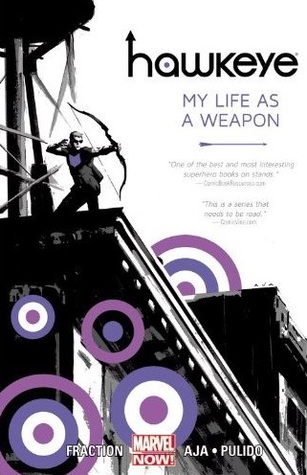
Hawkeye, vol. 1: My Life as a Weapon

16002136

Title: Hawkeye, Vol. 1: My Life as a Weapon
Author: Matt Fraction
Artists: David Aja, Javier Pulido
Color Artist: Matt Hollingsworth
Letterer: Christ Eliopoulos
Associate Editors: Sana Amanat, Tom Brennan
Editor: Stephen Wacker
Publisher: Marvel
Rating: T+

For Marvel fans who haven't picked up a Matt Fraction comic book, you are missing out. Big time. This revamped Hawkeye comic takes place after the whole "Ronin" escapade. (For those of you who don't know what that means, basically Clint Barton aka Hawkeye, was thought dead, but surprise, he wasn't. Anyway so he decided to come back as a different superhero - a ninja called Ronin. While he was going ninja stuff, Kate Bishop took over as Hawkeye.) Clint is back, doing what he does best, beating people up, and getting beat up with Kate occasionally at his side - usually to save him in the nick of time. 

Not only is the art fantastic, but the writing's great too. And, the book reads differently than most comics - it's not very linear, but that's because it's supposed to give  you a sense of what it's like to be disabled. Why? Because Clint Barton is deaf. "WHAT?" you may say, "That wasn't in the movies." No it wasn't, but Hawkeye has always been partially deaf - 80% hearing loss. Most of the time he does lip reading, the comic is supposed to give you a sense of how some people live, jumping from event to event and filling in the gaps in between. 

The story starts with Hawkeye falling through the air only to crash on a car - it then skips to a hospital scene. Maybe this is why Hawkeye feels so relatable - he doesn't actually have any super powers, which means that when he falls, he falls hard and then spend several weeks in the hospital - when he gets punched - he has to bandage it up, meaning that he is always bandaged in some way or another, and this superhero work? It's exhausting. 

The story continues to show the reader how Hawkeye got his dog - Lucky aka Pizza Dog, and how sometimes even heroes need back up. And Kate Bishop? She's pretty fantastic back up. Below I've included some of the art that has good quotes and scenes.

He’s a normal dude trying his best to be a superhero. | Community Post: 24 Reasons Why You Should Be Reading Matt Fraction's Hawkeye:

From Hawkeye #3, by Matt Fraction & David Aja. I just started reading comics, but I'm in love with these.:

Kate Bishop. Just…Kate Bishop. | Community Post: 24 Reasons Why You Should Be Reading Matt Fraction's Hawkeye:

Clint Barton discusses the positive influence of Captain America. (Hawkeye #1):

Action from Hawkeye #2 by David Aja (artist) and Matt Fraction (writer). Kate Bishop and Clint Barton flee the theatrical bad guys.:

Yeah, so if you like comics, read it.

Rating: 


Wednesday, February 3, 2016

It's Alive! (Maybe) + Giveaway

Everyone wants to (re)create Frankenstein.

The book was getting adapted in Mary Shelley's lifetime - most famously when she attended a play only to discover when it started that it was an adaptation of her novel. (#famouswriterprobs)

The most recent film adaptation starred Daniel Radcliffe and James McAvoy in Victor Frankenstein. (Don't worry - you'll get a review. I just haven't seen the movie yet.)

But recreating Frankenstein is not an easy task. To date there have only been two successful film adaptations (always excluding the above-mentioned film which I'm sure will be the best yet): Whale's 1931 adaptation starring Boris Karloff, and Mel Brooks' parody Young Frankenstein.

Maybe it's this repetition that makes it so hard to piece together a new creation from the old scraps of a corpse that has been reanimated regularly for almost 200 years.

And for that reason, when a Frankenstein adaptation succeeds, it demands attention.

Kenneth Oppel's Apprenticeship of Victor Frankenstein trilogy (I use the word in the hope that the two book series will have offspring) is the best Frankenstein story, outside of the original novel and the 1931 film, that I have encountered.

If you've been here before, you might recall my review of the first book in the Apprenticeship trilogy, This Dark Endeavor, in which I praised the novel to the skies.

A review of the second book, Such Wicked Intent, would probably read similarly.

But because I don't like to do the same thing twice, (come on, you know this blog would be boring if it was consistent) this post will review two Frankenstein novels side by side - like two brothers, one of whom is trying to resurrect the other from the dead.

And, aside from both being YA Frankenstein adaptations, that plot point is the main thing Such Wicked Intent has in common with This Monstrous Thing - the steampunked Frankenstein story by emerging writer MacKenzi Lee.


The two resurrection plots differ in the details, of course: when his brother dies, Alasdair tries to reanimate him using clockwork; when Victor's brother dies, he tries to grow a new body in the hope that he can bring his brother's spirit back to inhabit it.

Oppel's book is a prequel to Mary Shelley's novel; Lee's is a re-imagining of Mary Shelley's world, in which the Frankenstein story is based on true events and the monster is created using gears and clockwork.

I found Lee's story interesting in that it featured Mary Shelley as a prominent character, and I liked the theme of Frankenstein meets Steampunk (because seriously, that's an awesome idea and why didn't I think of it?) I liked the characters, especially Alasdair (the Victor Frankenstein parallel), and Clemence (the capable girl with a secret). And the second half of the book completely hooked me. It was a fun story and one that I enjoyed.

But - and I mean this with no disrespect to MacKenzi Lee, whom I regard as awesome - This Monstrous Thing didn't quite live up to the expectations I had formed for it after reading the reviews on goodreads. It was and is a good story - and the first sentence of the book gave me chills - but when I place it beside Kenneth Oppel's Such Wicked Intent, I find that it pales a bit in comparison.

Oppel's Victor Frankenstein novels are alive(!) with passion, suspense, and a strong undercurrent of the Gothic. The characters are strong and vibrant, and the whole story has a dark, creepy edge that makes you shiver but with delight (if it were really, truly horrifying I wouldn't read it, so you can rest assured it's safe for you). Victor's character is so spot on it hurts, and I loved seeing Henry Clerval grow in this book. Elizabeth was as fiery as ever, and Konrad so likable that you really feel it when he - ok, he's already dead at the start of this book, so not a huge spoiler, really. Let's just say, lots of hyperventilation towards the end of the book.

Lee is a debut author with lots of promise; Oppel is a seasoned writer who knows how to manipulate the variables to in turn manipulate his readers. The choice to switch to present tense when Victor is in the spirit world is brilliant - especially since Victor feels the spirit world as more real and present than the living world, which uses the past tense. Oppel implies so much with just a change in tense. And that is why his Frankenstein story lives while so many others fall flat on their face and die.

Kenneth Oppel is a master storyteller, and as a creator, he puts Victor Frankenstein to shame.

Anyone else think this tombstone faintly resembles R2D2?

I've mentioned several Frankensteinian (if that's not a word it should be) stories in this post. And you could take one home. Or, rather... it could come to your home. That sounded ominous. But all I meant was that if you comment on this post, your name will be entered in a giveaway for one book or movie from the following list of Frankenstein-related fiction:

Frankenstein, by Mary Shelley

This Dark Endeavor OR Such Wicked Intent, by Kenneth Oppel

This Monstrous Thing, by MacKenzi Lee

Frankenstein, the 1931 film starring Boris Karloff

Young Frankenstein, the 1974 film by Mel Brooks


If you win, you can choose ONE of these items which will then be shipped to you. The item condition may not be Like New, but it will be decent, and it's free. (:

To enter the giveaway, answer one of the following questions by commenting on this post:

What's your favorite Frankenstein adaptation?

Have you seen the new Victor Frankenstein movie? What should I know? (no spoilers)

What is the worst Frankenstein adaptation you have ever seen?

Or, if none of these questions pertain to you, what do you think of when you think "Frankenstein?"


I'll announce the winner on this blog a month from now, so check back in on March 4th to see if you're the lucky one. May the odds be.... no. Good luck.

Thursday, January 14, 2016

Alan Rickman

“[The English language is] so rich and cruel and beautiful, like a fireworks display, and yet it can be so subtle and so crude. Marry that to the stage and something mysterious happens. Don’t ask me what. It’s magical.”  - Alan Rickman, Los Angeles Times, 2011.
I was going to write something poignant and poetic to honor Alan Rickman's passing today, but the more I thought about it, the more I didn't want to. Others, who knew him better than I did and can say more than I could, have already done that. Just look up Emma Thompson's beautiful statement on the event of his death, or the comments of his fellow Harry Potter stars. We lost a brilliant actor, and, judging from the comments of those who knew him personally, a kind and wonderful man who was also a deeply loyal friend. 

But in this (very brief) blog post I want to focus on this quote from the man himself:
“I think there should be laughs in everything. Sometimes, it’s a slammed door, a pie in the face or just a recognition of our frailties.”
As an actor, Alan Rickman was just as skilled at humor as he was at tragedy; in fact, he often mixed the two. So if you're looking for some laughs in the midst of everything, take a few minutes out of your day to watch this comedy sketch about how an app featuring Severus Snape would work:


Here's to you, Alan Rickman. You'll always be the only Snape to me.

Monday, December 28, 2015

A Review of The Force Awakens

Erin: There has been an awakening. Have you felt it?
Anna: Yes. Let's write a post about it.


Introducing The Wood Between the Worlds' review of

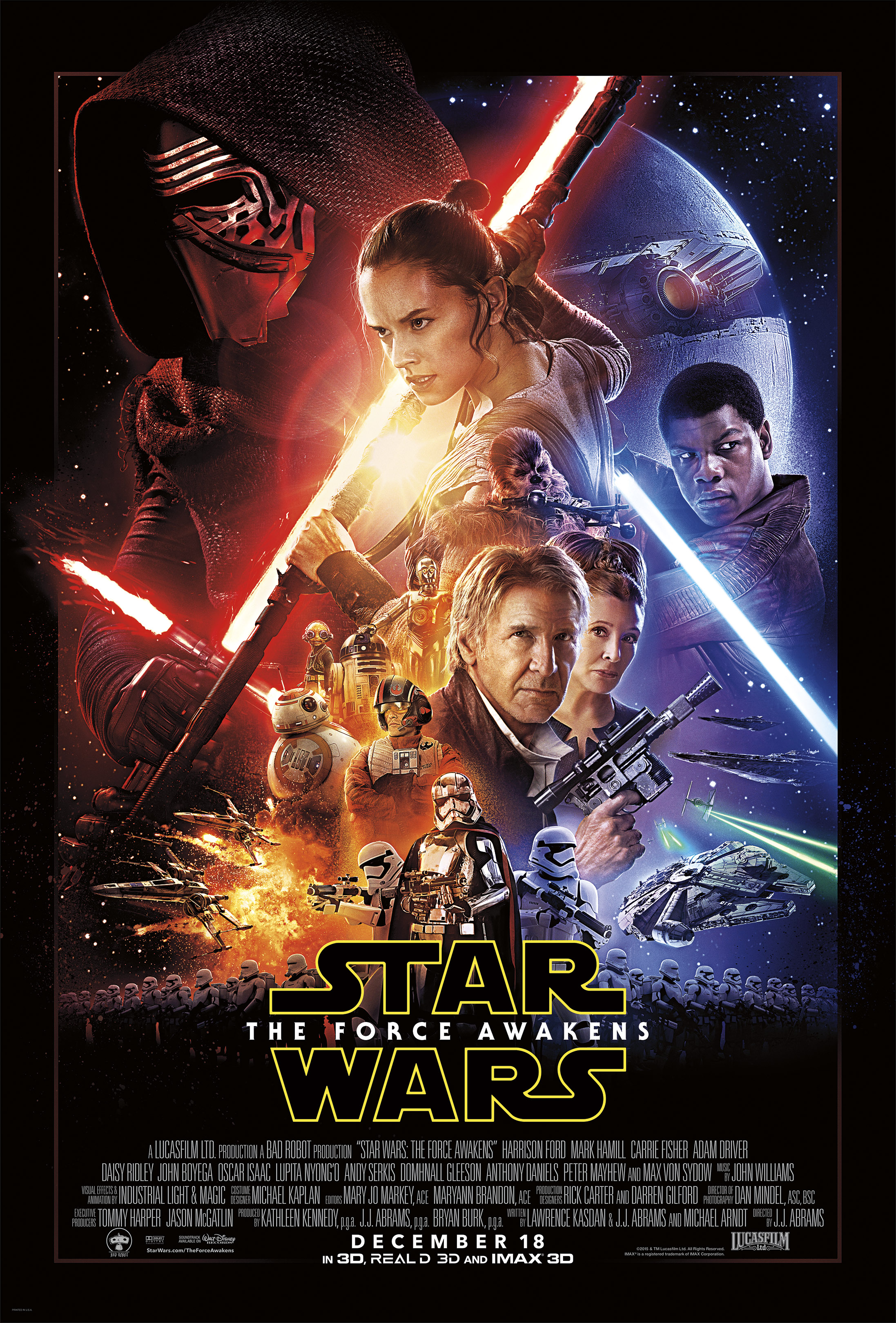
Star Wars Episode VII: The Force Awakens

Image result for the force awakens

"That's one hell of a pilot!" Within the first few minutes of the film Anna had already decided that Poe - the resistance pilot - was her favorite character - possibly because he had an awesome x-wing, more likely because he was extremely attractive. It was especially cool when he tried to shoot Kylo Ren. It may have seemed like a rash decision - why blow his cover, but he had already sent BB-8 away with the map, so that wasn't in any danger. But think about it, he may not even know this guy who gave him the map - we really have no idea but since it seems like no one that important really lives on Jakku it's safe to say that he's never met this guy before now, and yet he's willing to risk his life to save him. Something else great about Poe was his acceptance of Finn - their somewhat brief friendship was a great part of the film. Of course, every Star Wars film needs a good x-wing pilot - maybe Poe will replace Wedge Antilles. Erin liked his spunk, and relationship with BB-8. 

"The droid . . . stole a freighter?" BB-8 was adorable - we liked that he had a strong personality even though he was a droid. For instance his interaction with the powered down R2D2 was the cutest. 

"Not anymore. The name's Finn. And I'm in charge. I'm in charge now, Phasma! I'm in charge!" Finn was cool because he had a different background than the typical Star Wars character. There was quite a few things that mirrored the older films, but a storm trooper going rogue was unprecedented. One of the things that made us like him was how much he cared about Rey and how eager he was to impress her. At the beginning of the film Finn is super freaked that he will have to return to the first order, but by the end of the film he volunteers to go back to the Star Killer with just Han and Chewy to rescue Rey. 

"So, who is the girl?" The question on everyone's mind. Erin noticed that every time someone asked who Rey was, the scene immediately switched. So, who is Rey? We have some ideas about that, and they aren't all logical. 
    
Speculations
          1) Luke is Rey's father. 
                  For: The force is strong with her. She has an x-wing doll and helmet - which looks an awful lot like Luke's helmet. Luke's lightsaber called to her - a lightsaber that has been passed from father to son. Everyone seems to know who she is except for her. 
                  Against: It seems too obvious to be true. 
          2) Rey and Kylo Ren (Ben) are twins.
                  For: Kylo was very interested in her, and even offered to train her in the ways of the force. Han and Leia seem to really like her and know something about her. 
                  Against: If Kylo was sent to train with Luke, why was Rey abandoned on Jakku? If Han or Leia knew that Rey was their daughter they would've made a bigger deal out of it. 
          3) Rey is Wedge Antilles' daughter.
                  For: She knows a lot about piloting a ship, and has an x-wing helmet. Wedge was a very devoted member of the rebel alliance and made it through all three movies, he also isn't an obvious choice for Rey's father. 
                  Against: We just really like this theory.

Rey was a very strong character. She not only took care of herself - but she was smart and impressed all the people around her. Daisy Ridley did a fantastic job of portraying the force awakening within Rey. She had a very can-do attitude - and didn't plan on waiting for anyone to come save her - this is probably a result of surviving for so long on her own on the harsh planet of Jakku. 

"You're a monster." Uncontrolled and animalistic is a good way to describe Kylo Ren. He kept losing his temper and slashing things with his lightsaber when events didn't turn out as he would have liked. In the fight scene with Rey and Finn he kept hitting his side where he had been shot which was quite disturbing. Kylo's lightsaber mirrored his anger - it was very violent not only in color but in static. The lightsaber was constantly spitting energy, unlike Rey's which was calm and straight. 

Erin was impressed with little things throughout the movie which pointed back to the original films. For instance, she liked the random alien head that popped out of the sand to gawk at BB-8, as well as the scene transitions in the style of the old trilogy. That being said, there were moments that felt a little repetitive - like when they blew up the death star for the THIRD TIME. Erin's only criticism of the movie was that it felt a little too repetitive at times. But it was still great. 

Anna had no criticisms. Besides that Wedge Antilles wasn't in it - he's kind of her favorite character. (We don't know why . . .)